In 1974, Tom Oberheim released the
first Synthesizer Expander Module, or SEM.
Players loved this easy-to-use, ballsysounding
synth, and its unique multimode
filter gave it a distinctive sound. The SEM
went on to become the basis for some of
the world’s first polyphonic synths, such as
the Oberheim Two-, Four-, and Eight-Voice,
which were essentially multiple SEMs in
the same cabinet as a keyboard. Beginning
in the late ’70s, these gave way to more
compact analog polysynths (the Oberheim
OB-Xa behind Paul Shaffer on page 28
among them) but analog tone nuts still hunt
for original SEMs. Much to their delight,
Tom has now reissued it.
HANDS-ON
- You get 33 patch points on 1/8" mini jacks. The
SEM is compatible with all one-volt-per-octave
analog synths, transforming the SEM into a powerful
synth expander module, hence the name!
- Large coarse tuning knobs for each oscillator offer
a five-octave range; small pots above fine-tune
over a range of about a major third.
- Unique multimode filter operates in lowpass
and highpass modes and is continuously variable
between modes with a knob — at 12
o’clock it’s a notch filter. Slide switch activates
bandpass mode.
- These knobs combine the oscillator waveform
and mixer functions found in separate sections
on other synths: Center is off, left makes the
sawtooth louder, right does the same for the
pulse wave.
- Slide switch bypasses the VCA. Translation: infinite
sustain. This also lets users run external
audio inputs through the filter without triggering
the envelopes — handy.
THE SIMILARITY
STARTS HERE
In contrast to most second comings of
great analog synth names, the SEM is
almost identical to the original. In fact, the
external cosmetics are changed far more
than the innards. Tom tells us that just one
component was changed from the original
design due to lack of availability, and it
doesn’t affect the sound. He kept the
wedge-shaped beige case, and even the
knobs are the same parts as on the originals.
Some details have changed: two separate
tuning knobs work better than the
original’s touchy concentric arrangement.
The biggest difference is the 33-jack patch
panel. Since “bringing out” patch points is
a common mod on originals, Oberheim
took it one more step — a large step — providing
fantastic flexibility for interfacing with
other analog gear. Modular and Moogerfooger
maniacs rejoice!
MIDI AND THE SEM
The SEM’s extensive control voltage I/O is a
boon for serious fans of analog, but what if you
want to just wail on it from your MIDI keyboard?
Tom Oberheim will soon release the SEM MIDI
edition. This replaces the SEM’s left-side patch
panel with a nicely outfitted MIDI-to-CV converter,
and adds rear-panel MIDI jacks. Along
with standard note on/off reception, there’s an
auxiliary CV that you can control with your
choice of velocity, mod wheel, or other continuous
controllers. The aux CV destinations include
oscillator frequency, filter cutoff, and amplitude.
The MIDI panel also offers a portamento knob,
and expands the SEM’s audio input processing
with a preamp that lets you process low-level
sources such as mics and electric guitars. Also,
the MIDI panel works in standalone mode for CV
control of external synths.
THE VOICE
Oscillators. Two identical oscillators initially
give you a five-octave range. The tuning
knobs have no detents or marks on the panel, so pitch-perfect tuning requires a
tuner or reference tone. The upcoming
MIDI model (see “MIDI and the SEM” at
right will have an A-440Hz reference tone
that feeds the SEM’s external audio input.
On the positive side, the calibration is
extremely accurate. On my unit, the coarse
tuning knob swept exactly five octaves and the tuning never drifted. The oscillators
have saw and variable pulse/square waves
but no triangle or sine. Pulse can be modulated
via the LFO or envelopes, and is independent
for each oscillator. This can lead
to some seriously thick tones! There’s also
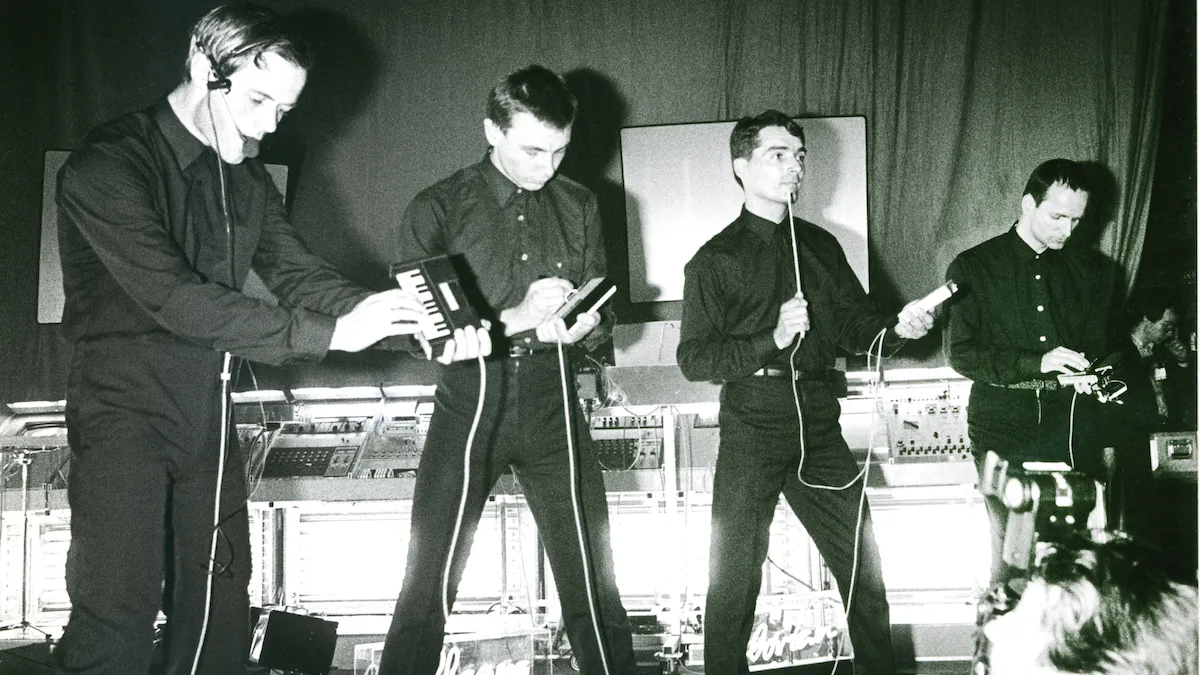
a sync switch for classic sounds a la the
Cars and Kraftwerk.
Filter. The filter is the famous two-pole
multimode Oberheim type. Due to its shallower
cutoff slope, it sounds a bit sharper
and brighter than four-pole, Moog-style
filters. The SEM can function in lowpass,
bandpass, or highpass modes for lots of
tonal variety. With the bandpass switch
turned off, the SEM’s filter is “state variable.”
That means you can mix between
low- and highpass modes with a knob.
Moving this guy around while playing
makes some great noises — too bad it’s not
a modulation destination!
Mixing. You may have noticed that the
SEM doesn’t have oscillator waveform
selector switches. Instead, centerdetented
knobs for each oscillator live in
the filter section; turn to the left to
increase saw volume or to the right for
square/pulse. This works fine, but doesn’t
allow waveform mixing within the same
oscillator. There’s one more knob for balancing
volumes from the two external
audio inputs, and this works the same
way — there’s no mixing of two sources.
Envelopes. There are two simple
attack/decay/sustain envelopes. There’s no
release segment — the decay knob does
double duty here, and decay continues
whether you hold a key down or not.
Whether this bothers you depends on the
sound, but let’s just say the SEM isn’t the
go-to synth for elaborate 14-segment
envelopes. Envelope 1 is hardwired to the
VCA (volume) and can control oscillator 1’s
pitch as well. Envelope 2 can control the
filter or oscillator 2. These are just the
“basic” routings — you can reroute the
envelopes in numerous ways using the
patch panel.
Modulation. There’s a sine-wave only
LFO with a solitary rate knob. So where do
you set the depth, i.e. how intensely the
LFO affects a given destination? You do it
at the destination: oscillator 1, 2, or the
filter. Finally, a VCA on/off switch acts as a bypass by disconnecting envelope 1 and
setting the VCA to full volume. This is
handy for drones or when you’re using the
filter to process a constant external input
such as a music track. All in all, the modulation
routings are surprisingly flexible.
Then there’s that patch panel! All the
audio and control voltage I/O you could want
is here. Unlike a full-blown modular system,
you don’t get a mixer or patching jacks that
can “mult” one signal to several destinations,
but that said, the patch panel is a boon for
anyone with CV/gate-type gear, be it a modular
synth, older analogs, or guitar gear with
CV I/O. The possibilities are staggering.
IN USE
If you’re familiar with analog synths, the
SEM should be way easy to get your head
around, requiring minimal manual-cracking.
(Tom Oberheim tells us a more indepth
version of the currently brief manual
is on the way.) Much like a Minimoog, the
SEM’s simple controls array makes sound
creation a joy — the absence of menus and
confusing abbreviations is a breath of fresh
air. All the expected analog sounds are on
hand: big, aggressive bass, piercing leads,
blips and thwips, and those brassy splats
that vintage Oberheim synths are famously
good at. By using bandpass and combined
lowpass/highpass filter modes, all kinds of
midrangey variations from spitty highpass
to mellow horn-like timbres are on tap.
Teamed up with my Synthesizers.com modular
and MOTU Volta, it sounded like the
end of the world — in a good way.
Being a pure analog synth, there’s no
patch storage whatsoever, but for true analog
aficionados, this may not be a big deal. The
lack of savable presets does tend to make the
SEM more of a “studio” instrument though.
As to sound quality, instead of using
tired buzzwords like “fat” and “warm,” let’s
put it this way: Compared to using virtual
analog plug-ins, the SEM sounds like the
difference between mono and stereo (even
though its output is mono), or like someone
took a dank tarp off your studio monitors.
The thing sounds that good.
CONCLUSIONS
Depending on your viewpoint, the SEM
represents either a steep price for a
monophonic synth with no keyboard, or
it’s the bargain of the century. It faces
obvious competition from Dave Smith’s
Mopho and its four-voice sibling, the
Tetra (reviewed Jan. ’10). Both of these
are true analog synths and have MIDI and
patch storage. But the specs only tell
half the story. With their digital
encoders and menus, their user interfaces
are less immediate than the
SEM’s. Sound quality is a hotly debated
topic in the synth world, but my ears say
that out of everything wearing the analog
badge today, the SEM’s is as analog as
it gets.
The SEM’s knobs and pots make sound
manipulation a whole lot of fun, the patch
panel lets you get creative even without
any other gear — some pretty crazy cross
mod/sync madness is just a patch cord or
two away. For my money, the SEM is a winner.
Thanks for keeping it real, Tom!
PROS
Silky analog sound. Discrete analog circuit
design. Unique and flexible filter. Modularstyle
patch panel has options galore for
interfacing with other analog gear.
CONS
You either get the patch panel or MIDI,
but not both. No memory to save presets.
INFO
$899, tomoberheim.com
NEED TO KNOW
What is it? A monophonic analog
synthesizer module.
Does it have MIDI? The version
reviewed here doesn’t. You’ll need
either a hardware MIDI-to-CV converter,
an analog synth with CV outs, or MOTU
Volta (reviewed Aug. ’09).
Can I save patches? No, but this
means knobs are fully analog and
not digitally scanned, allowing finer
resolution.
Who is it for? Die-hard analog synth
heads who crave the warm, big and
fuzzy sound that only a true analog
synth can provide.
How does it compare to other
synths? The SEM offers the purest
analog synth experience available
short of springing for a modular synth.
The oscillators, filters and amps use no
digital components.