The pulsating intro to “Baba O’Riley”
ranks among the most instantly recognizable
soundbites in rock history. Though many
believe it sprung from one of Pete Townshend’s
massive ARP synthesizers, it was
actually a Lowrey Berkshire home organ. Its
repeat function added a sixteenth-note
pulse to held notes — a gimmick for imitating
mandolins and marimbas. With multitracking
and clever note phrasing, Townshend made
this sound like the future of music.
We’ll recreate the “Baba” intro in Apple
Logic’s ES2. [The Korg Radias, reviewed
Aug. ’06, also has a killer ready-made
“Baba” patch called “Hooz Next.” —Ed.]
The track has two parts: the basic root-fifthoctave
figure, and the additional note flourishes,
both using the same patch. You can
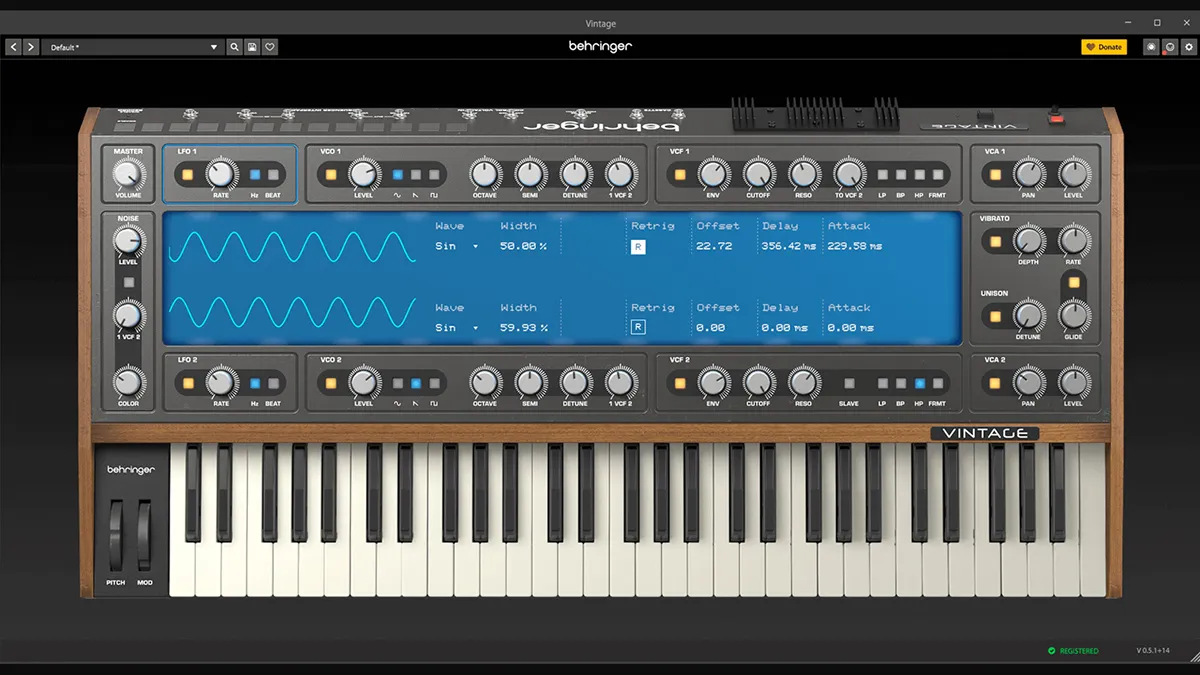
do it on many virtual analog synths, with
one condition: The synth must have a low
frequency oscillator (LFO) that retriggers
with each key press, as opposed to a common,
free-running LFO. Why? Most of the
flourishes Pete plays are two held notes
struck a 32nd-note apart, creating a
“bouncing” auditory illusion as one note
plays and the other is silenced. If two notes
struck at different times pulse in perfect
sync, the Baba patch won’t sound right;
you want independent pulsing for each
note. On synths that let you select poly or
mono LFO modes, use poly.
- Set two oscillators (oscs 2 and 3, in
this case) to thin pulse waves for an
organ-like sound.
- Tune the oscillators an octave apart.
- Detune them by one cent.
- Mix their volumes equally; in ES2, you
place the dot equidistant between the
two oscillators on the triangle grid.
- Use a bandpass filter for a midrangey
tone with few extreme highs or lows,
and add some resonance.
- Turn up ES2’s Drive knob for more lo-fi
vibe. Leave filter envelope settings off.
- Set the volume envelope as follows:
attack at 10ms, decay at zero, sustain
at full, and release at 12ms.
- To get the sixteenth-note pulse, in
ES2’s first modulation slot, set Target
to Amp and Source to LFO1, and move
the green amount slider up to almost
full. (If your synth doesn’t have an amp
or VCA mod destination, you can
modulate a lowpass filter whose cutoff
frequency is set to zero instead.)
- Set LFO1’s rate to 7.9Hz, and the
waveform to a downward saw. Now,
held notes will pulse.
As to effects, I added an EQ with 4dB of low
cut at 72Hz, 7dB of boost at 2,150Hz, and a
high shelf cut of 8.5dB at 4,400Hz for a ’70s
tape sound. Logic’s GoldVerb on a bus provided
small-room ambience. I also panned
the main sound left and the reverb right.
Now, duplicate the channel strip on two
DAW tracks. Set tempo around 117 bpm,
and record and quantize the F-C-F-C figure
on the first track. Let this play in loop mode
while improvising flourishes in the key of F on
the second track. It’s hard to describe, but
you’ll instantly hear when you have it right.
Click here for a supplemental page with audio examples and full notes on them.