By JERRY KOVARSKY
 |
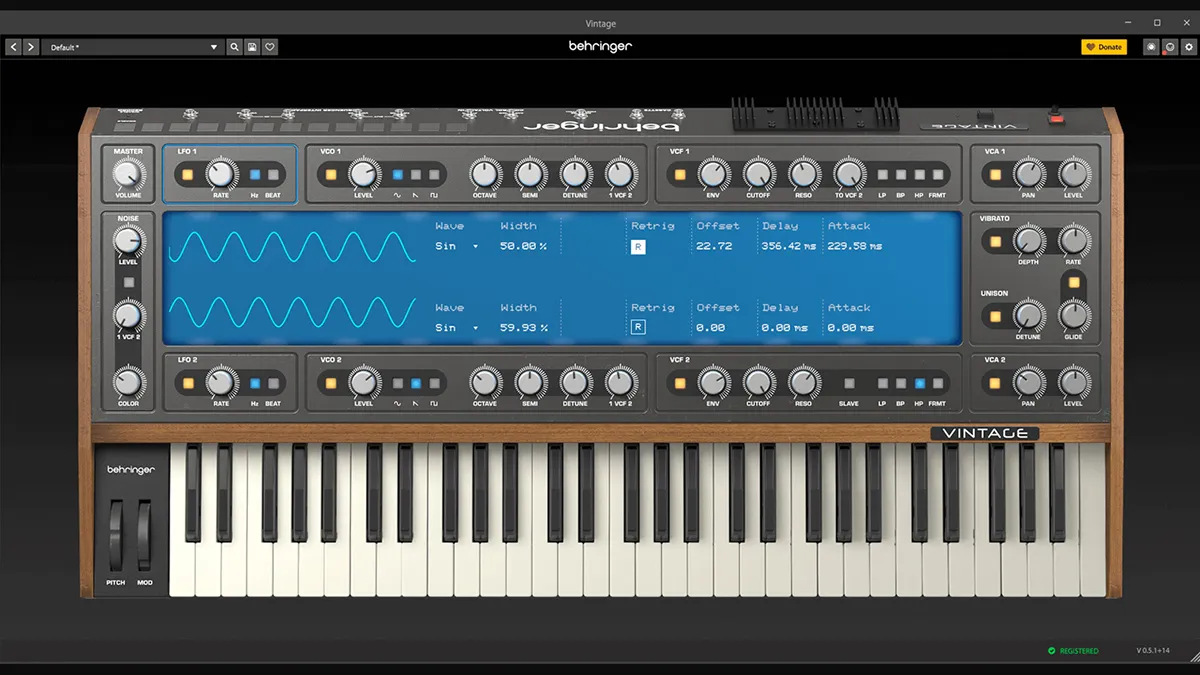
| Fig. 1. Sync, oscillator tuning, and envelope settings for a model sync patch. Note that the VCF EG (filter envelope)
is tasked as a sweep source for the pitch of the slave oscillator (VCO 2) in the VCO Modulation section. |
WELCOME BACK, MY FRIENDS. For the last few columns we've been
exploring filter sweeps and effects programming. This month, let’s dive in to
one of
the classic types of synth sounds that can impart a bold timbral character to
your
playing: synced oscillators.
That Syncing Feeling
The basic science of oscillator sync is that one
oscillator (called the master, usually oscillator 1)
is set to modulate another (called the slave, usually oscillator 2) so that the
waveform cycle of the
slave resets every time the master finishes a cycle
of its own. When the two oscillators are tuned to
different frequencies, the master forces the slave
to reset at irregular intervals, which produces
interesting harmonic results. Most of you will
recognize the sound as “that Cars patch” from the
song “Let’s Go.” (Keyboardist Greg Hawkes used
a Prophet-5 on the recording, patch 32. Or was it
17? Discuss. . . .)
In a sync sound, the primary pitch is produced
by the master oscillator, which is tracking the
pitches you play on the keyboard. The tuning of
the slave oscillator, which produces the signature
tonal character, can be set either of two ways:
tuned to a static or fixed pitch, or swept by a modulation source, usually an
envelope generator set
to sweep and then stop, as opposed to a repeating
envelope, or cyclic LFO. Both of these possibilities
provide interesting resources for soloing. Let’s go!
Swept Sync
Call up a sync patch on your synth of choice—you’re
not likely to find this sound on a basic ROMpler,
unless it’s a static sample that you won’t be able to
modulate in the ways I’ll describe. So reach for an
analog synth, be it real, virtual, or software. The
patch may have “sync” in the name, or you may be
able to turn on sync manually somewhere in the
oscillator or modulation section. Most “classic” sync
patches sweep the pitch of the slave oscillator, typically with an envelope. The
basic shape is a fast to
medium fast attack, a slower decay, and a sustain
level of zero so the pitch settles back down. Figure
1 outlines the most relevant settings for a basic sync
sound on Korg’s Mono/Poly soft synth.
The Decay value is critical,
as it defines the length of your
sweep. Every time you play a note,
it triggers the envelope shape,
and your slave oscillator’s pitch
is swept accordingly—classic sync.
It can also be interesting to sweep
the pitch manually when you hold
a note. Depending on the synth
you’re using, there are a couple of
ways to do this. The simplest is if your synth
lets you modulate the envelope sustain level.
Raising the value will sweep back up through
the whole timbral change, and when finished
you can return it back to the zero value. We set
the modulation matrix (called “virtual patch”
on the Mono/Poly) to use a controller of choice
to modulate the Filter EG Sustain point. You’ll
want a variable modulator like the mod wheel,
a ribbon, a knob, or a slider. Figure 2 shows a
simple setup using a controller sending MIDI
CC 17—set the Intensity to taste.
If your synth can’t modulate the sustain
segment of an envelope, or your patch has a
looping envelope that you don’t want to interfere with, you can route a
modulation source
directly to the pitch/tuning of the slave oscillator. Figure 3 is an example of
this using Rob
Papen’s Predator.
With either of these approaches, you can
now enjoy the originally programmed sweep
when you trigger new notes, and then take
control manually to repeat that sweep while a
note sustains. Setting the amount or depth of
the modulation lets you choose how deep you
sweep the slave oscillator, and by leaving the
controller “up” (not at zero) you can change the
start point of the sweep that occurs when you
play a new note.
Having a continuous controller assigned to the pitch of the slave
oscillator is cool because
you can retune its pitch whenever you want.
Some players like to have the ADSR parameters
assigned to controls on their keyboard so they
can completely reshape the sweep in real time.
Changing the decay stage can be very effective,
too: Shortening the decay and playing new
notes will give you a choppy effect that can
then be “relaxed” by opening it back to a longer
value. All of these concepts are in this month’s
online audio examples.
Tuned Sync
The other class of sync sound tunes the slave
oscillator to a fixed pitch—one that accentuates harmonics that you like. So
how do you
interact with this type? One approach I like
is to set a modulator to retune the slave pitch
to another, equally cool pitch.
Modulation routing is the same as
before: Set a CC with a modulation
amount that produces the desired
sound at its highest setting. Then,
assign a switch or button to send
a value of 127 for that CC when
pressed and a value of zero when
pressed again. Now, you can hit
the button to activate the alternate
sync timbre, then hit it again to
snap back to the original.
You can use more than one modulator to
do this, so you can have three, four, or more
different tuning ratios pre-planned, adding
a lot of diversity to your performance. The
only limit is the modulation capabilities of
your synth. Figure 4 is the Mono/Poly again,
with four different controllers set to produce
varied tunings.
I prefer toggle (a.k.a. latch) over momentary behavior for the switch,
since I can “set
and forget” the alternate pitch while I’m busy
playing, pitch-bending, sweeping filters, and
using all the other tools in our growing arsenal.
That said, momentary can be a cool effect when
you keep pressing the switch rapidly, producing
a repeated, alternating timbral effect. So try
both and hear what I mean. Until next month,
happy soloing!