by Craig Anderton
 |
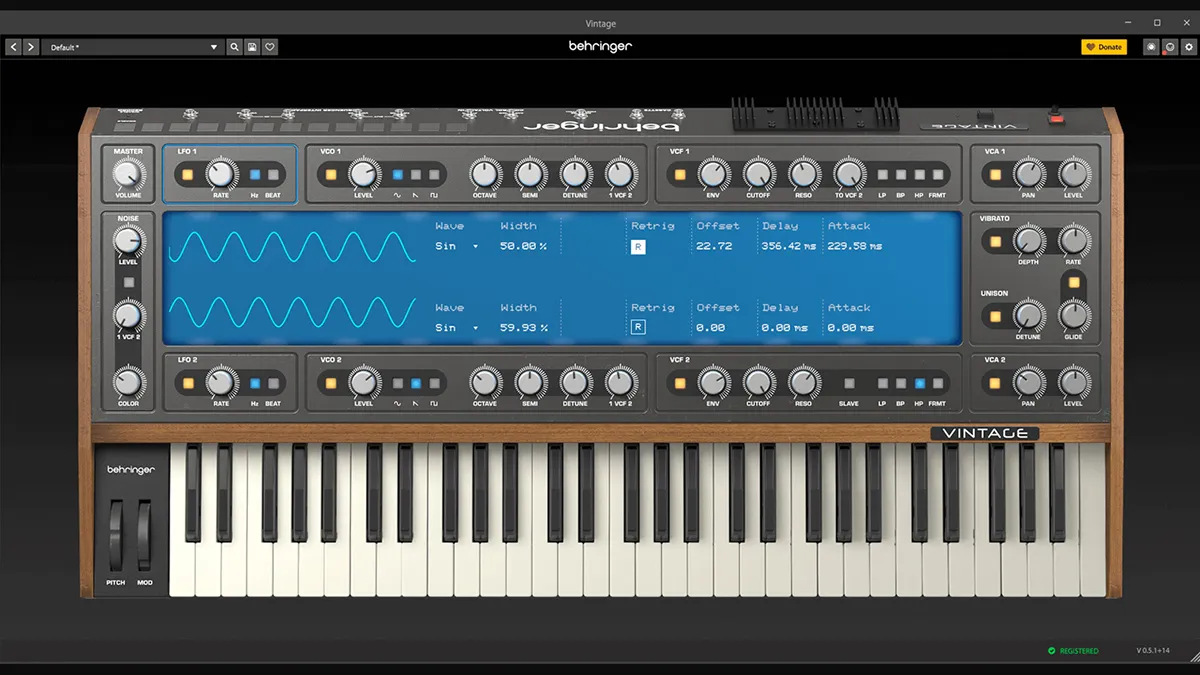
| Fig. 1. Padshop’s interface is easy to navigate and edit. Voice controls are at the top, with the granular engine underneath. The white vertical lines indicate grain playback location. |
WHILE KNOWN PRIMARILY FOR CUBASE, STEINBERG HAS INTRODUCED SOME
EXCELLENT INSTRUMENTS—HALion, Xphraze, Groove Agent, and others. As the name
implies, Padshop is all about pads, but these aren’t your father’s choirs and strings.
Padshop uses granular synthesis, which is like musique concrète on a subatomic level:
Instead of cutting up little pieces of tape and putting them back together in a different
order, Padshop cuts up samples into tiny “grains” and plays them as streams
of sound. Playback can jump around sequentially or randomly, and create rhythmic
patterns. Thanks to micro-level crossfading, you don’t hear any clicks as one grain
transitions to another.
Overview
Padshop incorporates a dual-layer granular
synthesis engine, filter section, and modulation
matrix for the onboard sources (two
envelopes, two LFOs with six waveforms including
sample-and-hold variants, and the step
modulator shown in Figure 2 on page 68). You
can also apply modulation from other MIDI
controllers, including VST Note Expression
from Cubase. Each granular layer is completely
independent; switching layers is almost like
switching between two instances of Padshop. While it doesn’t affect the sound, props to the
functional yet aesthetic panel graphics, and the
obvious, ergonomic user interface.
The Granular Engine
Other than simply calling up one of the 400+
presets, sound generation starts with loading a
sample into each of the two engines; you can opt
to use just one layer, or load the same sample
into both. You can’t load your own samples, but don’t expect to run out of options given the
329MB of included content. You then specify
the sample range (from which the grains will
be derived), the base position within that
range, whether to randomize or offset the playback
range, and set the “spread” of the location
of the grains that play back (further apart, or
closer together). You can also choose whether
to loop the sample, and the speed with which
grain playback progresses.
In words, this all sounds abstract, as you can’t
reference a conventional oscillator architecture;
the best way to understand how these parameters
affect the sound is to play with them and
listen to the results.
There are also more general settings that
relate to grain playback, and settings that
affect the grains themselves. We’ll avoid going
into a lot of detail (this is a review, not a
manual), but suffice it to say that the various
granular synthesis engine options allow for
major sonic variations that are far removed
from the usual freeze-dried sound of standard
sample playback. It’s the variations of grain
motion, grain shape and length, playback
parameters, and in particular, randomization
that create the compelling, evolving, nonrepetitive
sound of Padshop.
It’s easy to “tame” the pitch of the synthesized
sounds by defining pitch based on that of
the original sample, or by editing the grain playback
parameters to impose a sense of pitch. You
can do random pitch changes and detunings, and
transpose up or down one octave.
While the grain engine is exotic territory,
filtering returns to the familiar. The filter has a dedicated ADSR envelope (with velocity
control over amount), key follow, and 12
filter types. In addition to cutoff and resonance
options, you can introduce one of four
distortions: tube, solid-state, bit reduction, or
sample rate reduction (fixed, or with key follow
so the rate changes as you play up and down
the keyboard). These add a very useful element
when you want more “radikal padz.”
Sounds
 |
| Fig. 2. The Step Modulator (two to 32 steps) is a welcome addition to the usual modulation sources. |
The range of sounds is very wide—from the clarity
typically associated with FM synthesis, to
warmer, more analog sounds, to sounds that defy
conventional synthesis references. They’re ideal
for soundtracks, chill, trance, ambient, and much
more—this really is your one-stop shop for pads.
Granted, Padshop is pretty much about pads—
but they’re so stellar and editable that it greatly
expands that genre’s boundaries. The presets
are also not throwaways; Padshop will keep you
happy for a long time with just a tweak here and
there of the supplied library. Sometimes turning
just one control will create an entirely new and
wonderful sound, but if you like it, save it! A few
more tweaks and you might not be able to get
back to it again.
Conclusions
I suppose by now I should be jaded by synthesis—
but then something like Padshop comes along.
It’s unfortunate it’s VST3-only, but thankfully
Steinberg didn’t code the plug-in to work only
in Cubase. If you want to experience something
new, different, and very cool, Padshop offers up
sounds you probably haven’t heard before—while emphasizing there’s more to “sample-based”
than pianos, strings, and drum loops. Even if
you’re not into pads, playing with Padshop might
change your mind. If you are into pads, you’ll fi nd
Padshop as useful, engaging, and downright beguiling
as I have.
Craig Anderton is Executive Editor of
Electronic Musician magazine and Editor
in Chief of HarmonyCentral.com
Snap Judgment
PROS Rich, evolving pads
that would be diffi cult or
impossible to create by
other means. Inexpensive.
Not difficult to learn but
plenty of options. New approach
to synthesis.
CONS VST3-only. No standalone
mode. Can’t load your
own samples.
Key Info
SYNTHESIS TYPE
Granular with filters, envelopes,
and matrix modulation.
GRAIN STREAMS 8.
SYSTEM REQUIREMENTS
Mac: OS 10.6 or 10.7. PC: Windows
7. Both: Dual-core CPU, 700MB free
disk space, VST3 host program (32-
or 64-bit), Internet for activation.
COPY PROTECTION
Steinberg eLicenser USB dongle.
Bottom Line
More than expected for the price.
The sounds are evocative, sophisticated,
and novel.
$49.99 download | included in
Cubase 6.5 and Cubase Artist
6.5 updates
steinberg.net