Every recording needs bass. Well,
maybe not flute duets, but everything else.
So every virtual studio needs a soft synth
that delivers strong bass. Spectrasonics
Trilogy, released in 2002, provided great
sampled acoustic and electric bass, and
became the go-to virtual bass in many
studios. Trilian takes the Trilogy concept
into the stratosphere.
You’ll need a hefty computer. The library
weighs in at a whopping 34GB, and some
presets require more than 2GB of RAM.
That’s more than just a separate sample for
each key — each key has a number of articulations,
and each articulation has several
“round robin” samples, so that repeated
notes don’t have that identical, machinegun
sound. Above all, Trilian is playable.
I installed Trilian in my new Windows
7 PC, and soon discovered that I’m on
the bleeding edge of technology. With
Image-Line FL Studio 9 as the host, Trilian
occasionally freaked out the audio
buffer, resulting in loud noise bursts.
I’ve reported the problem, and with any
luck it’ll be ironed out before you read
this. In Steinberg Cubase 5, Trilian was
well-behaved.

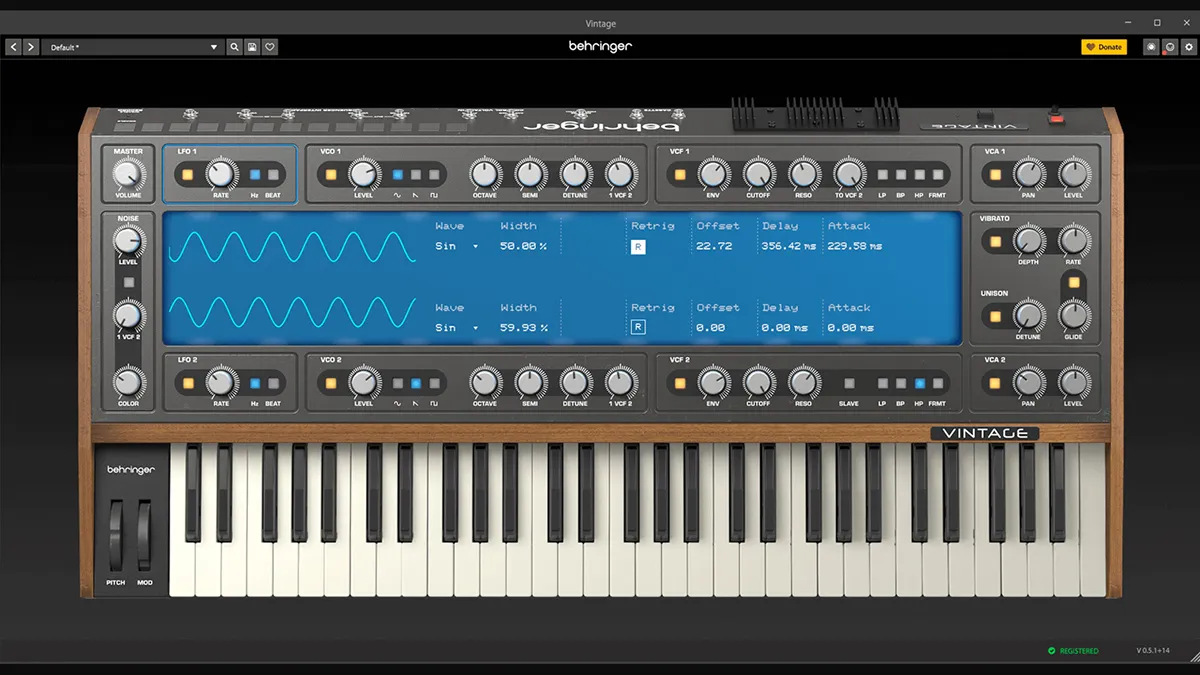
HANDS-ON [Click image at left for large version.]
- 1. You get eight multitimbral parts, plus a multimode
mixer.
- 2. Each patch has main, edit, effects, and arpeggiator
panels.
- 3. The two layers can be mixed, muted, and
transposed with these controls.
- 4. Six LFOs can be synced to song position for
reliable sweeps.
- 5. These quick controls affect both filters in a
layer.
- 6. The envelopes are multi-segment, so the familiar
ADSR sliders are just for quick adjustments.
- 7. To program your own sound, load a waveform
from the library here.
- 8. The magnifying-glass buttons open more pages of
editing controls.
SOUNDS
Acoustic, electric, and synth basses are
ready to go in Trilian. There are four
acoustic basses: one from Trilogy, one from
Bass Legends, and two new ones. The new
ones are actually four-channel recordings of
the same acoustic bass, split into two pairs
of miked and direct combinations. A Martin
acoustic bass guitar, which has a round
tone, is also included. With the acoustic
and electric basses, you can mix miked
samples with direct pickup samples —
phase-locked, of course.
The electric bass category is bigger.
Sounds you didn’t get in the original Trilogy set
(which Trilian includes) include a Bissonette Studio Bass, Chapman Stick, Clean Fender,
Hardcore Rock, Retro ’60s, and Rock PBass.
Each of these has a number of presets
for articulations: staccato, slides,
muted, harmonics, and so on. Bass slaps
and pulls are part of the deal, and are
playable from the keyboard. Even legato
trills are supported. Up to eight articulations
can be loaded at once in Live Mode (see
below). Within the basic preset, velocities
of 127 trigger short, sampled slides up to
the note, adding to the playability.
Release noise doesn’t require a separate
layer of the patch, which is good, and
you can adjust its loudness with a slider.
You can mix and match, tacking release
samples from one bass onto another. The
release noise volume depends on the
length of the note, so long notes that have faded out don’t have an ugly pop when you
lift off the key. That kind of detail makes a
big difference.
Trilian is hardly the only source of greatsounding
synth bass, but what’s unique
about it is the library of sampled waveforms
from analog gear. The instrument list
includes the ARP 2600 and Odyssey,
Cwejman, Dave Smith Mopho and Tetra,
Korg MS-20, Metasonix Assblaster (a tubebased
box that defies description), four
different Moogs, Novation BassStation,
Oberheim SEM, Oxford OSCar, PPG
Wave, three different Sequential Circuits
synths, six Rolands (including the SH-101
and TB-303), and a few others.
Generally, these synths were sampled
with the filter wide open, so you can use
Trilian’s great-sounding filters and
envelopes to sculpt your sound. There’s no
reason to use the waveforms just for bass:
Trilian is just as capable of doing warm
pads and screaming leads. Because Trilian
plays samples rather than generating analog-
type waveforms via modeling, however,
its lead synth tones aren’t as creamysmooth
in the high register as those in virtual
instruments such as Omnisphere
(reviewed Dec. ’08). But hey, this is primarily
a bass — and anyway, lead tones with
an edge are good sometimes.
SYNTH ENGINE AND EFFECTS
Trilian’s dual voice layers will be familiar if
you use Omnisphere. In each layer, you get
six LFOs, four multisegment envelopes, two
multimode filters with serial or parallel routing,
FM for roughing up the tone, and threevoice
detune/panning for fatness. The 19
filter modes include not only the expected
types but a couple of metallic resonators. A
modulation matrix with 24 routings gives you
plenty of ways to massage the tone.
The effects rack includes more than 30
modules: compressors, EQs, delays, distortion,
an amp/speaker model, three
reverbs, and more. Each of the two sound
layers has its own rack of up to four effects,
four more are available in the preset’s common
rack, and Trilian’s mixer panel has four
aux send racks and a master rack.
PERFORMING
Eight bass slots might seem like overkill,
but in Live Mode, Trilian lets you play up to eight articulations (one per slot) on the fly,
using bottom notes on a keyboard for
switching. With a little practice, I could
play realistic electric bass parts with
slides and pops. For adding them after
the fact, you can easily insert the
keyswitch notes into your sequencer’s
piano roll.
Just as useful is Trilian’s main panel,
which has 11 controls you can play via
MIDI messages. They’re pre-assigned to
do useful things in presets (e.g., mix direct
and miked signals on a bass guitar, or do
filter cutoff and resonance on a synth bass)
but you can re-assign them to control as
many sound parameters as you’d like — at
once. The main limitation is that there’s no
way to offset or limit the values: Assign a
knob to five parameters, and it’ll move all of
them from 0% to 100%.
I was especially impressed by the Chapman
Stick preset. The real Stick is played
by tapping, so hammer-ons and pull-offs for
legato lines are a big part of the technique.
The Trilian Stick plays these techniques
even in the middle voice of a chord! Any
pair of overlapping notes that are a half- or
whole-step apart will be legato, while notes
further apart will sound separately. I’ve
never seen another synth that did this.
Trilian’s arpeggiator isn’t fancy, but does
a few useful tricks. If you drag in a MIDI file
from Stylus RMX, the arpeggiator will lock
to the RMX groove. You can program up to
32 steps, which can be notes or rests, and
can be linked for longer notes. The duration
and velocity of each step can be
programmed, but transposed steps and
chords aren’t supported.
CONCLUSIONS
With Trilian, you really can fool listeners
into thinking they’re hearing a fine bass
player recorded in a pro studio. A knowledge
of bass styles will also come in
handy: Trilian is a musical instrument, and
begs to be played by a skilled musician.
The attention to detail in the sample
library is scary, the voicing parameters are
powerful, the user interface operates very
smoothly, and the sound is amazing. Trilian
isn’t just the best virtual bass on the
market, it sets the gold standard for years
to come. For these reasons, it clearly
deserves our Key Buy award.
PROS
Extremely realistic and playable acoustic
and electric basses. Very musical management
of articulations on the fly.
Deep sound programming options.
Searchable HTML manual lives on your
hard drive.
CONS
Requires lots of RAM.
INFO
$299 list/approx. $279 street, $99
upgrade for Trilogy owners,
spectrasonics.net
NEED TO KNOW
What is it? A soft synth with a massive
34GB library of sampled bass
sounds.
What kinds of bass sounds?
Acoustic upright, acoustic bass guitar,
over 60 electric bass guitars,
Chapman Stick, and hundreds of
synth basses — mostly analog.
Plug-in formats: Mac or PC; VST
or AU.
Will it run standalone? No, it
requires a host — either your DAW or
a gig-oriented program like Apple
MainStage.
Copy protection: Online
challenge/response with serial number.