Roland Juno-G

 
Peter Kirn ,Jun 01, 2007


OVERVIEW


Despite its price and retro styling, the Juno-G really is a “Fantom-Xpress.” It’s got the processor and sound engine from the pricier Fantom-X line, minus some of the extra bells and whistles. You still get Fantom-class sounds, a multisampled grand piano, compatibility with Roland’s SRX expansion boards, onboard audio and MIDI recording and editing, lots of effects, and a powerful arpeggiator. That makes the Juno-G an unusually feature-packed workstation relative to other budget keyboards.

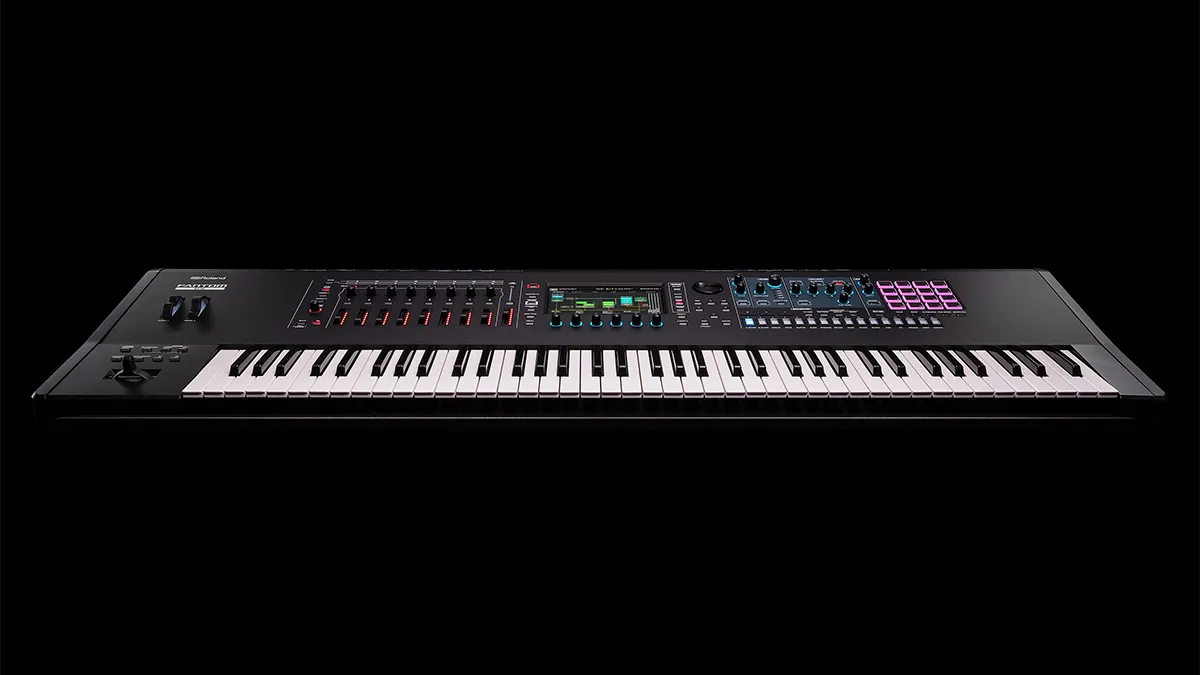
Though the Juno-G is more Fantom than Juno (see “What’s In a Name” on page 54), it gives a nod to the vintage Juno’s color-coded front panel and large, generously-spaced sliders. To my eye, these retro controls are far more attractive and easy to navigate than those on the Fantom-X proper. They’re also a refreshing change of pace from the sparse physical controls on many budget workstations. For preset viewing and menus, the Juno-G sports a large, orange backlit screen, similar to that found on the Fantom-Xa (reviewed June ’05). Big labels and a big screen means this is one keyboard that won’t feel like an exam at the eye doctor.

SOUNDS AND EDITING


If you’re looking for a preset machine, the Juno-G delivers. The front panel groups presets by helpful categories (piano, keyboard/organ, world, brass, etc.). You get loads of sounds in just about any category you can think of, quick access to editing, General MIDI 2 compatibility for playing imported MIDI files, and a single SRX slot for optional sound expansion ROM. In the base soundest, roughly 1,000 presets are squeezed into 64MB of wave ROM.

That’s the good news. The bad news is . . . roughly 1,000 presets are squeezed into 64MB of wave ROM. Some, like the main piano sound, are a marvel of economical patch design. It won’t pass for a Steinway, but it will cut through a mix at a live gig with a distinctive, biting timbre. Other pianos higher in the preset banks start to sound thinner and more generic, as you might expect. One tip, though: Often a quick adjustment of the filter knobs or change to the effects routing can transform a mild-mannered sample into a raunchy monster. Those knobs and buttons are at your fingertips for a reason.

Despite its smallish wave ROM (in this age of multi-gigabyte software instruments), it’s difficult to overstate the depth of the sound engine inside. A flagship workstation’s sonic brains are hiding in an entry-level case. You get dozens of editable effects with flexible routing, 128-voice polyphony that stands up to playing with both forearms on most patches, and seemingly endless editing options. Within a basic preset, you can program everything from independent envelopes for each of a sound’s four oscillators to specific multi-effects settings. This is most easily done on the front panel, though power users could get lost in the extensive, included software editor (see Figure 1, above right).

The multi-effects are particularly welcome, with plenty of great-sounding reverbs, choruses, and dynamics processing. Where the collection falls short, unfortunately, is at the lo-fi end: overdrives and distortions are ho-hum at best.

The Juno-G excels at pristine and “real” instrument sounds, and certainly has no shortage of synth leads, basses, and pads, but if replicating analog warmth is your top priority, you’ll want to look elsewhere. Say, at Roland’s own SH-201 (reviewed Nov. ’06), which has the analog-modeling sound engine the Juno-G lacks. The Juno-G does have something else I liked about the SH-201: lots of front-panel controls to provide easy access to tweak-tempting parameters such as filter cutoff and resonance, filter and volume envelopes, and LFO settings.

AUDIO AND MIDI RECORDING


The big bonus on the Juno-G is its integrated song recorder and player, which is capable of recording four audio tracks alongside 16 MIDI parts. Audio and MIDI tracks coexist as part of a song, though you do have to edit audio tracks on a separate page. On the back end, the audio recorder is really a sampler — you can bring up a list of clips, each with their own file names, and perform the usual sample editing functions on them. On the front end, though, it’s like having a souped-up four-track tape recorder built into the keyboard. Unlike the Fantom-Xa, you don’t have to think about dropping samples into a sequence to get external audio into a song. You simply record it like any other track. Each of those four audio tracks is stereo, too, but no, you can’t finagle ’em into eight mono tracks.

While you can accommodate a dynamic mic by cranking up the Juno-G’s audio input gain, you’ll get the best audio quality by using an outboard preamp for mics or guitars. If you record on something other than the Juno-G, you can import audio from your computer via USB file transfer or memory cards. Both the audio and MIDI modes support looped recording for layering takes quickly, and the sequencer’s track editing features are quite deep — more than enough to sketch songs without ever touching a computer.

Still not convinced you want audio recording on your keyboard? You can use recorded audio as the waveforms in your own sounds, which then take full advantage of the G’s synth architecture. The internal RAM stores less than a minute of sound, so you’ll need to add more by installing a DIMM, as you would on a computer. Audio gets recorded to this memory temporarily, and is lost if you power off without saving; when you save a song, you can write it to a non-volatile memory card (such as Compact Flash, SmartMedia, or SD). As on the Fantom workstations, you’ll need an adapter to put your card format of choice in the old-school PC card slot on the rear panel. These are easily found at consumer electronics and office supply stores. It would be better still if you could pop in a card and record to it directly, as you can on portable recorders such as the Edirol R-09.

In USB storage mode, a computer connected to the Juno-G over USB will see the keyboard as a storage device. While this means you can drag and drop audio files as though the Juno-G were a hard drive, the USB connection does not stream audio — to do that, you connect the old-fashioned way using a line out to a separate audio interface. Of course, USB MIDI is supported. By contrast, the SH-201’s USB port will stream audio, and you can run its editor as a plug-in within VST-compatible host software, whereas the Juno-G’s editor is standalone only.

PERFORMANCE FEATURES


Even without some of the more advanced workstation features of the Fantoms, the Juno-G is an extremely versatile performance synth. Press just two buttons on the front panel — Arpeggiator, then Edit — and you’ll see what I mean. The arpeggiator is really a full-fledged pattern and rhythm sequencer, with an editable, 32-step, 16-pitch grid, and a hold feature. It can also work with the chord memory to play arpeggiated chords. Unfortunately, there’s no pattern-based recording, as found on Korg’s TR series.

In true Roland fashion, you’ll find a “V-Link” mode for controlling Edirol video hardware in sync with your keyboard performance. There’s also Roland’s signature D-Beam infrared controller, made more fun by a built-in, Theremin-like solo synth mode.

Where the Juno-G really shines for live use is in its sophisticated performance set features. These can load banks of sounds, with layers, splits, drum kits, and song data containing both audio and MIDI, along with various other settings, effectively giving you ready-to-go performances. Combined with the audio and MIDI sequencing capabilities and hefty pattern features, this makes the Juno-G a terrific gigging keyboard at a fraction of the usual price. It will take you some time to work through the methods for programming these options, but the preparation pays off.

IN USE


Conventional wisdom seems to dictate that software is difficult, and hardware is easy. Yet I think I’m not alone in having avoided big workstations because I find that they’re complicated to learn, tend to have cluttered screen layouts, and can be a pain to lift and transport. What I found terrific about the Juno-G’s pared down size and feature set was that it felt more useful in my setup as a result. In fact, it’d be great if the same elegant front panel design could be applied to higher-end Roland workstation keyboards.

I do often wish I had a keyboard with solid built-in sounds and effects to complement my computer rig, or for quick recording so I don’t forget or dilute an idea before I’ve gotten it down, and for that, the Juno-G was perfect. I found it immediately accessible, and was able to dig quickly into recording sketches with the song recorder, setting up arpeggiator performance patches, and supplementing my software sound banks with some on-demand instruments. Having spent some time with the Juno-G, I’m now thinking about how it might fit into a live computer set, with some pre-programmed performance setups and audio loaded onto Compact Flash cards for backing tracks or use between sets.

It’s also important to remember that not everyone wants to use a computer-based DAW for songwriting, and it’s with these musicians that the Juno-G really scores a bull’s-eye. If that beat you just made inspired some chords, and the chords inspired a melody you want to sing, which in turn inspired a solo you want a bud to play on guitar, it’s hard to think of any one keyboard instrument that makes every step of that process this easy and fun.

CONCLUSIONS


Lots of instruments right now are gunning for the slimmed-down workstation market, but the Juno-G hits a real sweet spot. It trims down distracting controls, but by taking a page from one of Roland’s great panel designs of the past, does so in a way that’s actually more readable and accessible. It reduces the amount of bells and whistles, but without sacrificing a powerful sound engine and effects. Lastly, it eschews some of the more gimmicky, pre-recorded pattern functions while giving you deep MIDI, audio, and pattern editing and recording that can either stand alone or complement a computer.

Korg and Yamaha each offer their own instruments in roughly the same price class. The Korg TR61 (reviewed Feb. ’06) offers some slick modulation routings, song arrangement templates, and easy pattern recording, and the Yamaha MO (reviewed Sept. ’06) has additional computer integration features (especially for Steinberg Cubase users). Both of these have slightly higher list prices, but they’re close enough that you’ll most likely choose based on preference for signature sounds. There are also slightly cheaper alternatives, but I think the Juno-G easily justifies the small extra cost. For a well-rounded keyboard that will grow with you, the Roland Juno-G is tough to beat.


Leave a Comment
Name:
Location:
Average Rating :
 

Chester Thompson B-3 Master Class

Ten Minute Technique - Warming Up Under the Gun

The Chord Doctor - Expand Your Chordal Command

Get Funky on the Rhodes

Synth Sense - Hot Synth Licks for Non-Synth Players


What's the best recipe for the image on the cover of Keyboard each month?
 
Subscribe Live Bookmarks Advertise Contact Us Privacy Policy Terms & Conditions


Keybord Magazine is a trademark of New Bay Media, LLC. All material published on www.keyboardmag.com is copyrighted @2009 by New Bay Media, LLC. All rights reserved