Retro Disco Ooh La La

 
Michael Gallant


Snuggly contained within a black jumpsuit, her blond hair blown back as if she were facing a storm head-on, Alison Goldfrapp sets her vocal mic aside and sings into an auxiliary one to her left on stage. Her whole body seems to go into the process of pouring vocals into the audio chain, then into the ears of her enthusiastic Times Square audience. But the sound that actually reaches the largely glammed-out crowd indicates that there’s a lot more at work: Instead of Alison’s clean, sensual soprano, we hear grinding modulation and twisting pitchbends, an unexpected sonic treat that ignites cheers and applause throughout the theater. For a delicious eight bars or so, Goldfrapp’s frontwoman appears to be more synthesizer than singer.

“It’s a Korg MS-20,” explains Alison, relaxing with tea at New York’s Hotel on Rivington the following day. “Our backline guy, our sort of Wizard of Oz, was back twiddling knobs.” She makes squealing, synth-esque noises with her voice while miming the Wizard’s tweaking. “So that happens in real time. You have to really go Aaah at full pelt, constantly. You can’t waver off it. Otherwise it doesn’t register.” To Alison’s left sits Will Gregory, the other half of the critically acclaimed retro synth band. “She’s piloting it,” he adds, smiling. “And he’s just making sure it doesn’t crash.”

Watching the ease and humor with which Will and Alison interact in words makes it easy to understand how they function so symbiotically in the world of music. Though Alison fronts the band that bears her name and Will no longer performs live, Goldfrapp’s creative process rests firmly on two pillars: equal collaboration and lots of synthesizers. And as the band’s latest release Supernature (Mute) makes obvious, said creative process leads to strikingly good music: Dark, sexy, dance-happy beats and sweeping disco synths mix with the sort of catchy, melodic songwriting that draws you in, whether you’re chilling by the radio or bumping on the dance floor.

Alison, you’re the frontwoman and singer, but you also do a lot behind the scenes. How would you describe your role in the creative process?

Alison: It’s hard to categorize what your job title is, exactly. We write everything together and it’s different every time; sometimes you start with a vocal melody, but that vocal melody might end up being a string melody. My voice becomes my tool for a lot of things — coming up with melodies or drumbeats or whatever. The way we work in the studio is this: bouncing ideas off each other, jamming, and playing the odd synth.

We tend to write and record simultaneously. What you pick as a sound influences how you write. So really, production and writing and recording all get wrapped up together. That whole side we do together and we get someone else to come in and mix the album.

How’d you get into synths and electronic music?

Listening to disco, ‘70s music, and ‘80s music. It’s funny because when people listen to our music, [they think] it’s ‘80s influenced because they always associate synthesizers with that decade. There’s actually very little music in the ‘80s that I liked that had synthesizers. I found it too cold. It’s more of the ‘70s stuff that seemed to be a bit more organic and soulful; a lot of disco music that used strings and crazy sounds and mixtures. And Prince as well, with his whole drum programming thing.

And then, obviously, Will introduced me to a lot. I was slightly intimidated, I suppose, but that’s what’s great about synths, and especially old ones. You can go absolutely crazy on them and they just sound wonderful, whatever you do. [Laughs.]

Do you have a favorite piece of keyboard equipment?

I really like the old Roland String Synth we did “Number One” on, and we started using it all the time. And we’ve got this old Russian synth that looks great because it’s all written in Russian [Cyrillic] and you can’t understand anything it says. It’s completely uncontrollable, so you think “Oh, this is a great sound,” and then it goes fffffft into something else. That’s fun. And the keys are so light because they’re so cheap and nasty and old. And then there’s the other Roland as well — the SH-09. I played a bit of “Train” on it. It’s a great thing because it’s got a little wand on it and a little dial. It just makes great noises, really.

Why is Will a good creative partner?

He’s very talented. [Cracks up laughing.] Don’t get embarrassed, now! [Spoken to Will, who pulls his sweater up over his mouth.] A lot of people I’ve worked with in the past have been talented musicians, but were usually quite boring and rather conservative in what you’re supposed to do and what you’re not supposed to do. Will’s very open. Also, he’s very good at interpreting ideas. I can say something in a completely rambling, almost incoherent way and, remarkably, he seems to understand it quite often.

What are some of the synths you used to record Supernature?

Will: We just started with a few. When we first toured with Goldfrapp, I used to play live on the MS-20 and I know that synth really well now. I used it a lot as a treatment, since it’s got a great filter in it. I also started buying some old ’80s polysynths. There’s one called the Paraphonic 505, which was a Roland string synth. It’s great. I think Roland and Boss pioneered this stereo effect that ended up being Dimension D — which is this chorus thing that appears in various amounts in various devices as well as a chorus pedal — and this synth has this wonderfully stupid chorus ensemble. It doesn’t sound anything like strings, but its quite epic, so that’s quite good.

I’ve also got a pair of Oberheim SEM modules that I really like. I haven’t really gotten into the soft synth thing, but I think they’re great, and people get fantastic results with them. The esoteric ones where there isn’t an analog equivalent . . . when people start using the computer in ways beyond what’s been imagined, that’s when it starts to get interesting.

To what extent was the computer involved in the album?

It’s right there in the middle. I use [Apple] Logic 6.4 on a Macintosh G4. When you’re jamming, you just go back, find that bit, loop it up a hundred times. It enables you to capture performance elements that are quite human, but control them in a way that keeps it in a good place to work from. That’s what we always like to do, to keep some live performance human element, whether it’s someone wheedling on a machine or whatever it is. If you really need to sort out the timing, just edit it.

Did you use any MIDI in the studio?

I don’t really like drawing in MIDI data. I’d rather just record it again and practice it on the synth to get the performance I want. You just put it on loop and play until you get it absolutely the way you want it — or cut it together from all the different takes or whatever you want. I treat the computer as a recording machine and a problem solver: If there’s something there that isn’t quite right, it can help sort it out, tune it, time it.

With all the choices that music technology gives you, how do you narrow the options and keep from going crazy?

It is a problem, isn’t it? Not only does the computer multiply possibilities, it also subdivides time. You can expand time, literally, and zoom into fractions of a bar that were until now visible only to NASA scientists. Some of the really good programmer people — that’s one of the things they realize. People like Squarepusher and Aphex Twin are dividing the minutiae of events and what happens in a tiny nanosecond right on the borders of your perception.

But I don’t think that’s how we work. I’ve always wanted the computer to just help represent something that’s produced by humans, however inefficient that is. You can make certain parameter decisions, rules, like if you’re jamming over song structure. One rule you could make is that yes, you can take any element of the jam, but you can only use it in the position that it occurs in the jam. Supposing there’s a moment that happens just before the second chorus. Just because you like it doesn’t mean you’re allowed to move it to any position in the song. If you want it, that’s where it happened in the jam, so that’s where you use it. That might be one constraint you can impose to limit the amount of choice. And then you can decide to break that rule. [Laughs.]

You can make little rules that, if you’re using the computer as a recording machine, then all you should be doing is opening a window on a performance rather than endlessly tweaking it. I think it is a problem, and I do think sometimes you have to limit your options. Sometimes I’ve had situations where we’ve had twelve bass parts, minimum. When we mixed the last album, the mixer would call out “right, 64 and 65, what should we call that one? What is that one, Will?” “Well, that’s a bass,” I’d say. “66 and 67, what’s that one, Will?” “Well, that’s a bass.” And after we got so far into it, he would just look at me: “Another bass, right? Don’t tell me. . . .” It can get a bit silly.

Were those bass tones alternate takes of the same part?

They were all different sounds that all had bass functions, you might say. Rather than having a bass player come and play, we used a mosaic of parts that were all in that frequency range.

Were they all from different synthesizers?

Quite often. Not 64 different synths . . . but a bass is a very expressive part of the sound, isn’t it? It’s basically the top and the bottom of what you register. My New Year’s resolution — less basses. It’s good to try all those choices, and very often, it’s easy to layer things up. The sound itself isn’t quite right, so you put another sound on top of that, to try and improve it, then another sound on top of that because it’s got a bit more top and bite to it, but actually, the more sussed approach is to spend longer trying to find the right sound in the first place.

One of my favorite things about Supernature is how you use vintage tones while making them sound like something very new.

I’m not very well versed in the history of how these things are used. Some of my friends can take a Minimoog, go duhduhduh [Motions tweaking knobs.], and there’s the sound from “Good Vibrations.” Duhdhuduh . . . that’s more the sound from Herbie Hancock’s “Deathwish.” That’s very admirable, but I’ve never been that knowledgeable about it. I’ve always been more duhduhduh . . . I like that sound; it sounds emotive.

Because of the hard disk, you can be more extreme: You can have the sound go very intense, then edit it hard into a more rational moment. It’s not just us. There’s a whole realization that these instruments are only 20 years old and therefore a lot of them have a lot more to offer than has been discovered in that time. Like a violin — or I was going to say a tuba, but that’s not such a good example. Anything that composers have then gone on to use for years and years and get different interpretations out of them. I’m sure that’s what’s going to happen with these synths, because they have a very large range of possibilities.

How do you approach tracking with vintage keyboards?

You can shove them straight into your mixing desk or put them into an amp. I’ll tell you what I’ve been getting into easily, which is blindingly obvious, now that I think about it, but it didn’t occur to me early on. [Effects] pedals. It’s something guitarists have known about for quite a long time really. You get a bunch of pedals and then you’ve got a bit of a range, and pedals work great with synths. They open up so many possibilities.

Are there any songs on Supernature you use lots of pedals on?

Yeah, nearly all of them. Particualrly this one type of fuzz pedal that’s on “Slide” and “Ooh La La” and “Horse” and “Lovely 2 C U.” I’ll tell you what type in a year’s time.

You mentioned jamming in the studio earlier. Are you both on keyboards? And do you both have mics?

I tend not to have a microphone, but Alison’s really good at jamming on the keyboard, so sometimes we take turns on the keyboard, and sometimes I’m playing keyboards and she’s singing. In fact, on “Ooh La La,” I played this bass line while she was singing and her mic picked up quite a lot of me clattering on the keys. We actually used that in the chorus. It sounds awfully like horses galloping.

We tend to mix and match, really. She’s very intuitive with keyboards, and she gets things out of them that I could never achieve.

Speaking of Alison, now it’s your turn: Why is she a good creative partner?

She’s got a lot of sounds down in her head and if you can get into the right place for us together, she’s amazing. This stream of ideas will come out. It’s like a “go” button. And also she thinks quite laterally. She’ll come in in the morning and say, “You know that bit there that’s the bridge? That should be the chorus, and then we can turn that bit around. I’m going to take that line there out and put that synth line in and sing that lyric to it.” She’ll come up with ideas that I’d never come with, basically, and I hope the same is true the other way around. We’re quite good at covering the bases that the other doesn’t cover — right from the most obvious things like she sings very, very well, and I can’t sing at all — to more subtle things. I think the common ground is that we both seem to know when we think something’s good.

What advice could you offer to musicians trying to wrap their heads around vintage synths?

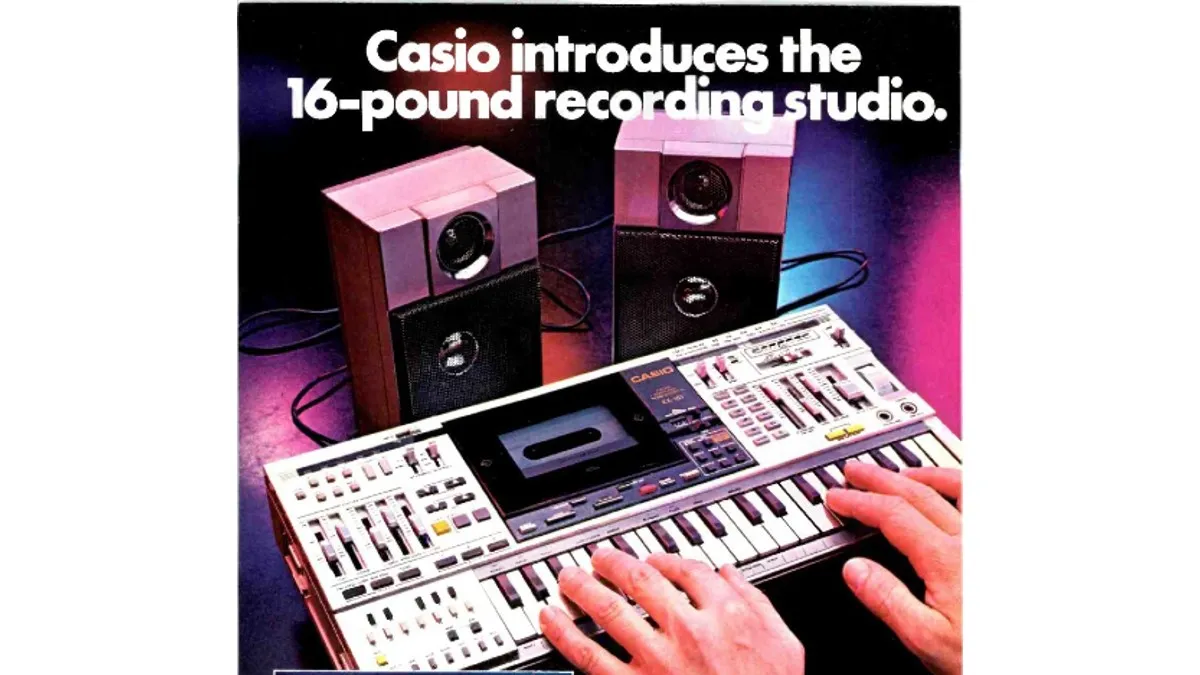
When you’re hunting for old things, follow your own instincts and not try to do anything anyone else has done. It’s quite interesting to forge out into your own territory and not take anyone else’s word on anything. Often something will be quite out of fashion, then someone will use it, then it’ll be flavor of the month again, so just follow your own instincts. You could be the one to make the Casiotone the world’s coolest instrument again.


Leave a Comment
Name:
Location:
Average Rating :
 

Finger Independence

Chester Thompson B-3 Master Class

Ten Minute Technique - Warming Up Under the Gun

The Chord Doctor - Expand Your Chordal Command

Get Funky on the Rhodes


What type of product has improved the LEAST over the past 10 to 15 years?
 
Subscribe Live Bookmarks Advertise Contact Us Privacy Policy Terms & Conditions


Keybord Magazine is a trademark of New Bay Media, LLC. All material published on www.keyboardmag.com is copyrighted @2009 by New Bay Media, LLC. All rights reserved