Mika’s latest offering, The Boy Who
Knew Too Much, is a sonic circus of sorts.
It’s classic piano riffs bathed in church
choir cadences, harmonized vocals over
stop-time drum marches, and hip-hop
beats colliding with pop panache, (a la
Beyoncé meets the Beatles). Hard to
describe but immediately recognizable, the
album is very much like the award-winning
British singer/songwriter himself: much
more than just the sum of its parts.
Mika burst onto the international stage
in 2007 with “Grace Kelly,” from the quintuple-
million-plus selling album Life In Cartoon
Motion. Borrowing the best elements
from rock heroes of yesteryear (most
notably Queen, Elton John, and the Beatles),
Mika’s exuberant, piano-centric sound
returns in 2009, marrying razor sharp songwriting
with an imaginative arranger’s acumen.
At once celebratory and introspective,
The Boy Who Knew Too Much is a portrait
of an artist firmly committed to telling his
own singular story.
On the eve of the album’s release, Mika
and I met in midtown Manhattan to talk
about the sounds that shaped this new
collection of songs.
One of the things that struck me when
I heard the new album is that while
you’re obviously a piano player, the
songs aren’t locked down ‘piano
songs.’ I think that’s a credit to your
songwriting.
Well, it’s also a credit to my bad piano playing.
[Laughs.] No, but I mean it. I was actually
sitting in a very weird dinner for
Universal, honoring Doug Morris, about
eight months ago. And it was very fancy,
and there were a lot of women with a lot of
plastic surgery sitting around . . . and that’s
only talking about the musicians.
You have to learn how to speak your
mind.
Indeed. And I was seated next to Paul
Anka. And he’s talking to me — and he’d
never heard my music — and finally he
goes, “So, are you a good piano player?” I
said, “In all honesty, no. I’m not that great.”
He goes, “Then you must be a good songwriter!
Anybody who’s too good, when it
comes to making pop music, it always gets
in the way.”
Now, that’s true and it’s not, because
some of the greatest writers in pop music
have been amazing players. But there are
advantages to playing very simply — to
approaching your instrument in a very simple
way — you always think of the song, as
opposed to the parts. That’s the way I play.
Also, I tend to rely on the piano as a
percussive instrument, for pushing rhythm
forward, because the subtleties of melodic
lines are not something that I can easily
bring out in my playing. I do it with my
voice, and then I use the piano as a harmonic
reference, but more than anything,
as a percussive instrument to drive the
rhythm. Often, the rhythm is kind of hidden
within the piano playing.
But I think your piano playing and
your sense as a songwriter are very
orchestral. Some guys play and sing in
one place, either vocally or on the
piano, as if they’re staying in their
comfort zone. But your comfort zone
seems to be all over the instrument.
Well, in terms of drama, it’s not being afraid
to go somewhere. Just because it’s a pop
song, doesn’t mean it can’t go places dramatically,
and I mean that in a musical
sense. There’s a song on the record called
“Rain,” and it’s kind of “side-shifting,” keywise,
because originally it had to transpose
to get into the chorus, and I realized I didn’t
want to do that. So it’s all about thinking
you’re in one key, then sidestepping and turning
the melodies from majors to minors —
you start turning things around so that you
don’t really know where you’re ending up.
Especially on this record, that’s become a
little bit of a game to me.
You like to experiment. . . .
Yeah, it was like a puzzle. When I was writing
the song, I fully admit it was like a puzzle. Like “How do I get into this chorus?” and “How
do I do it without anybody realizing that
we’ve changed the key?”
You’re 25, but a lot of your references
are decidedly old-school. I hear so
much early Elton John and Queen.
Harry Nilsson, too! The early Harry Nilsson.
Pandemonium Shadow Show, the first
record he put out on RCA, which was a
commercial disaster. That very kind of
taught, tight, pop storytelling, that he was
so good at. I think that’s why he became
the Beatles’ favorite songwriter, because
he was such a master storyteller in his
songs. But it’s very simplistic, at least on
the surface. Now when I write songs, I try
to keep it almost very naïve, and hide the
technique as much as I possibly can —
because technique never has charm.
In my kind of pop, I always try to make it
as simple as possible on the outside. But my
references are older. It’s kind of Harry Nilsson,
early Elton John, obviously, but not only
that. I listen to that, and the biggest
relevance I can find to that music, fast-forwarding,
is Depeche Mode, or synth-led
stuff by the Eurythmics, because all the
parts are so simple. But I do kind of run the
gamut, and I did come from a classical background,
but not as a pianist — as a singer.
There’s a real rootsy, go-for-broke
kind of element in your piano playing,
even though you downplay it. I guess
that makes sense given that your template
is people like Elton, and the way
Freddie Mercury played piano.
Well, [Queen guitarist] Brian May comes to
my shows, and I know him — he’s an
acquaintance, but we’d never been personal
friends, like on an outside-of-music
basis. I always wondered why he stayed
away from me, even though he always
comes to my shows and analyzes.
Finally, the other day, he comes backstage
— it had been three years since he last
saw me perform. He was kind of muted, and
he didn’t know what to say to me. He told
me he was weirded out by my piano playing,
because although he didn’t think there was
a lot of similarity between me and [Queen
vocalist] Freddie Mercury, when he heard
me play, it was shocking to him how similarly
we did play. And he said the drums relied on
the piano in Queen, that the drums worked
around the piano. So when he heard the
dynamic onstage with my band, he was
almost to a point of being mute — he couldn’t
believe how similar it was.
Did you listen to a lot of Queen coming
up?
No, not growing up. Later, yes. I did, and I
loved their musical fearlessness. Just
because it was pop music, didn’t mean it
always had to go, “A-B-A-B-A-B-close.”
We take for granted how much they
stretched the boundaries of what pop
music could be about at that time.
Yeah. Well, you didn’t know. It felt
completely natural. The best pop is anarchic
at its core, because it breaks all the
rules. But you never know that when you’re
enjoying it — you don’t have to “get” that
it’s anarchic to be affected by it.
So much rock music is so banal nowadays,
because it all sounds the same. I look
at all my favorite artists that made me go,
“Oh, I’d love to be like them one day,” and I
think of Bowie, and I think of Prince, and I
think of Freddie . . . all these people revolutionized
things, but kind of through the side
door, you know? They were unashamedly
populist, but they were also kind of anarchic.
I call it “Patti Page Punk.” If you want
to do punk, dress up like Patti Page and
sneak in through the side door!
Who were some other major
influences when you were coming up?
Disney soundtracks. I was obsessed with
them! Oliver Wallace, the guy who did all
the choral and men’s choir stuff on Peter
Pan. The Cinderella soundtracks. Kurt
Weill, and his Threepenny Opera and Lady
in the Dark. That’s the pop music of its day.
I mean, I’m not a big show guy. I’m not a
big Broadway obsessive. Kurt Weill is
probably as far as I go, but I love it. I love
that kind of attitude. That was really grungy,
Berlin art-house stuff that became
massively mainstream.
Obviously, I love Bowie. I love things
people wouldn’t necessarily think I would
like, as well. I grew up with Bob Dylan. It
was the soundtrack of my childhood in a
way. I also grew up with everything from
Cat Stevens to flamenco. It was really an
anti-snobbery. It wasn’t about who was
playing, it was just about what the music
sounded like. I was very lucky to have that
instilled in me.
Are you going to tour the album with
an acoustic piano?
No, because I think it’s a nightmare to be
tuning, and I abuse my pianos.
So what kind of rig will you play
onstage?
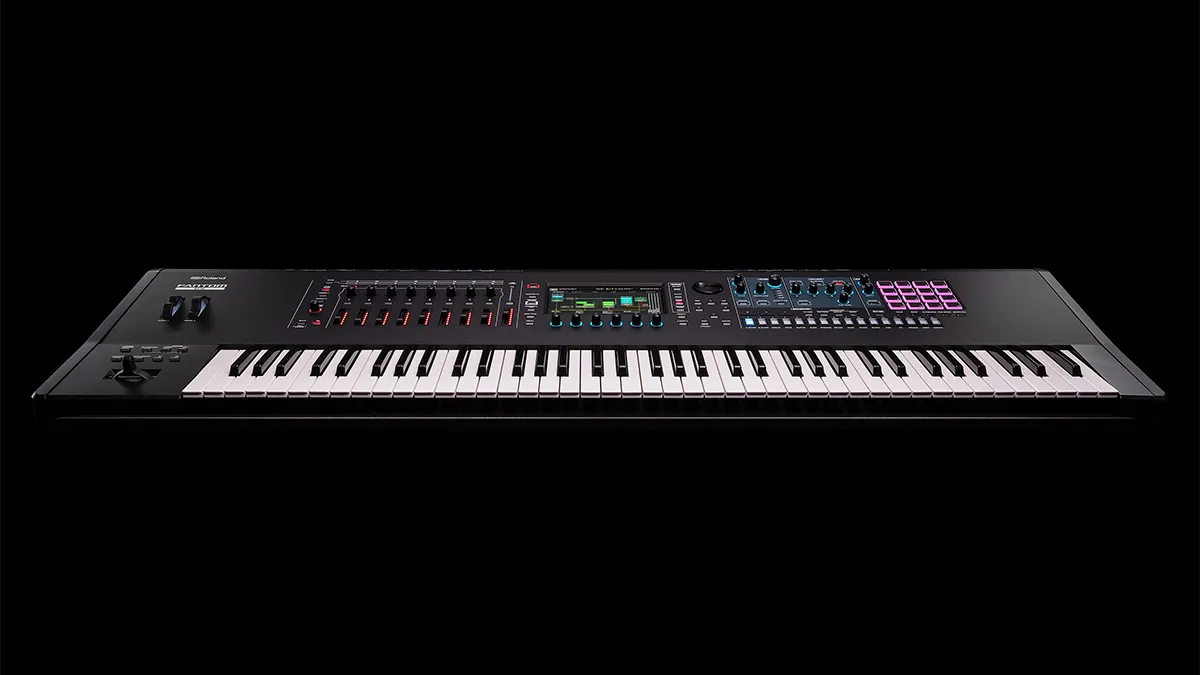
At the moment, I’ve been changing. I was
playing a Yamaha CP300 in the past. Just
recently I got a Kawai MP-8 fitted into a sixfoot
grand piano shell, which I had custom
made so I could dance on top of it. I’m also
going to try the new Roland V-Piano — I
hear they’re doing some amazing things,
and without sampling. I’m gonna see if
that’s the sound I need.
For more on Mika, visit mikasounds.com.