The look of Korg’s new PS60 is all business, not unlike their earlier
M- and T-series keyboards or a Roland D-50. While Korg’s designs for
the Radias, M3, and SV-1 are certainly more audacious, the PS60’s nononsense
appearance bespeaks its single-minded mission: To be taken
onstage and played live. You have to wonder if the lack of flamboyance
is calculated to enhance appeal in hard times: “Look, honey, it’s not a
flashy toy. Can I get one, please, can I, please?” The lightweight plastic
enclosure is reasonably rigid, and the panel is as organized and as easy
to read on a dark stage as it is in bright sunlight. (The LCD doesn’t fare
as well in the sun, but what LCD does?) It’s also appealingly compact.
More after these Web Extras:
Layout
Performance controls are at left and include a dedicated button for simu-
Leslie speed on organ sounds, octave and semitone transpose controls,
and four banks of five preset Performances per bank. A Performance is
a macro-level setup encompassing sounds, splits and layers, effects sends,
modulation effects, delay, reverb, and EQ. The Easy Setup panel at center
is where you choose sounds and build splits and layers on the fly.
Here’s where things get interesting. The PS60 is always in what many
other axes call multi, combi, or performance mode. All six sound categories
are available at the touch of a button. Want an acoustic/electric
piano layer? Light the On button under “A. Piano” and choose a piano
sound, hold that On button and press its counterpart under “E. Piano,”
then choose an electric piano. Balance to taste using the white volume
knobs. Done. Dare to create a massive, six-layer monstrosity? Light up
all six On buttons and go nuts. With 120-voice polyphony, you’re pretty
much ready for anything.
Keyboard Feel
When I placed the PS60 front and center in my studio, and before turning it on, I thought its synth-action keys were way too light and that they
bottomed out too softly. Why do I mention this? Because you might make
the same judgment if you encounter the PS60 at a retailer where they
don’t keep every unit plugged in. After I spent some time playing (what
a concept!), a whole new impression confronted me. The PS60 impressed
me as much with its keys-to-sound connection as the vastly more expensive
Yamaha CP1 stage piano. Granted, it’s a completely different feel
from anybody’s piano-weighted keys, but the PS60’s keys are a pleasure
to play because—and this is important—their response is so tightly
integrated with the internal synth engine. Many of the source samples,
if they don’t actually feature a dozen or so velocity layers, feel as if they
do. It’s so bloody easy to be musical. Okay, I’m gushing. Go play one
and find out why.
Sounds
Certainly we’re in bread-and-butter land—but it’s artisan bread and fresh
butter from a local creamery. The grand pianos in particular are gorgeous,
with plenty of girth, sparkle, and air. They’re everything you want in a
stage piano, and there are several tasty flavors. It’s here that the finger-tomusic
connection is at its absolute best. If you buy and connect a Korg
DS1H damper pedal (about $60), you get half-pedaling, too. Stretchtuned
pianos are offered; try them for solo piano songs or passages.
Electric pianos, both Rhodes and Wurly, are every bit as good, aided by
a clever implementation of the Lock button above the joystick: Push the stick
forward for tremolo to taste, then press Lock to keep it there. (Incidentally,
the Lock button can affect either, but not both, of the joystick’s axes.) Creamy,
swirly, snarly, Disney end credits—all the essentials are on hand, as well as
cool extras like digital, Prophet VS-style electric piano sounds, which are rendered
really well. Clavs and harpsichords live in this bank, too, including one
with the key-off noise of a real Clavinet with sticky old hammers.
Korg has great organ simulations, but CX3-style drawbar modeling
isn’t part of the PS60’s innards. The simu-Leslie isn’t as convincing as I’d
like to hear, but Korg has included a slew of drawbar tonalities, plus
delightfully cheezoid transistor organs for when you need to pump it up,
light someone’s fire, or cry 96 tears. If you spend most of your time playing
B-3 sounds, you’re probably going to get them from a dedicated
clonewheel anyway. All this said, the audio demo at keyboardmag.com
attests that even a relative hack like me can wring a decent Hammond
sound out of the PS60.
In Use
Spending a few weeks with the PS60 was really enjoyable. I used it in the
studio as both MIDI controller and sound source. The keys that I had
initially dismissed became my new favorite for playing soft synths, devices
in Propellerhead Reason, and the like.
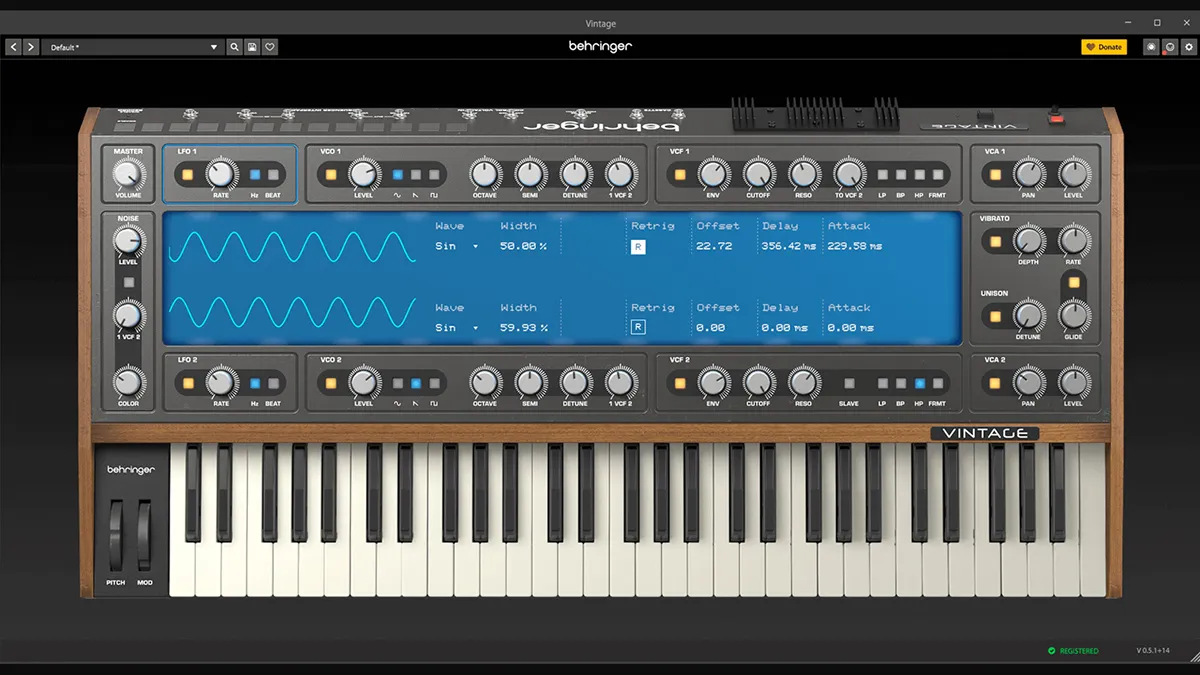
With the PS60 connected via USB and this plug-in or standalone editor running on your Mac or PC, knob and button moves on the PS60 update instantly onscreen, and vice versa. You can also automate the PS60 like a soft synth.
I cooked up a demo tune that answered the question: “What would
it sound like if Tower of Power had Donald Fagen and Bernie Worrell
sit in?” Since the PS60 contains no drum sounds, not even in a
General MIDI bank buried somewhere, Reason provided drums and
percussion. Since the PS60 isn’t a workstation with a built-in sequencer,
I recorded everything else live as audio into Pro Tools LE 7.4. I found
a perfect bass guitar among many worthy candidates in the Synth
bank, which seems to be more or less the “everything else” category
in the PS60.
Layering a Dyno Rhodes with a bright grand piano was a snap, and
with a little tweak to the phaser effect on the Rhodes, I had exactly the right texture. I tracked the layered piano-and-Rhodes in one pass. Building
a credible funk horn section required two passes with different sounds;
the PS60’s otherwise excellent “TOP Section” patch gave me a pre-made
split (this is a single program, not a multi) with a fat baritone sax in the
left hand and a sax-and-trumpet trio in the right. It sounded a little soft,
though, so I overdubbed a pass of “Killer Brass,” which skews more into
Jerry Hey territory. Mixed just under “TOP Section,” it added extra sharpness.
I also used the pitch bender to add very subtle “falls” to the end of
each brass stab on this pass. Korg’s joystick has always made this gesture
easier for me than a pitch wheel or Roland-style paddle. If the PS60 let
me layer Programs from the same category, I could have recorded both
brass sounds in one pass, but no dice.
After that, I tracked the organ, with some judicious volume pedal
work using the pedal from my Korg CX3. I used the “Distortion” patch,
which did a nice job of evoking Chester Thompson’s “Squib Cakes” and
“What Is Hip?” tones. For the lead synth sounds, I had so much fun blowing
through them that I can’t tell you exactly which ones I used, but I can
tell you there’s nary a ho-hum sound in the lot. Hiding in the Synth section
are a number of pretty good guitars as well, including a distorted
lead and a jangly, tremolo-dipped Telecaster.
Not only is there a great software editor included with the PS60, but
it also runs as a plug-in in all major DAWs, as well as standalone. It makes
working with the PS60 like working with a soft synth, right down to
automating all front-panel parameters from your DAW. (In Pro Tools,
you need to add those you wish to automate in a pop-up after clicking
the Auto button in the plug-in itself.)
The PS60’s editor wants to be connected to the PS60 by USB only; I
tried it with old-fashioned MIDI and USB at the same time because my
rig includes hardware synths connected via a vintage Midiman interface,
and I got a MIDI note loop that ate up the PS60’s polyphony and gave me
phasey sound no matter what the local on/off settings were on each end.
The fix was to go into Pro Tools’ “Input MIDI Device” settings and de-select
the Midiman port to which the PS60 was connected, so that Pro Tools
saw the PS60 over USB only. Not the PS60’s fault—just something to look
out for if your studio is “blended” like mine.
Conclusions
As I put a rig together for a tour with my band Maybe Tuesday, the PS60
is very attractive with its light weight, small size, low cost, fantastically
responsive keys-to-synth connection, and quick navigation. Using the
editor software beforehand and storing custom presets will save time. I’ve
seen some online forum chatter bemoaning the lack of a sequencer. That
misses the point—if you want a workstation, go get one. An arpeggiator
would’ve been useful, though. Though the absence of aftertouch detracts
from the appeal as a player’s axe, you can’t have everything at this modest
price.
The needs of weekend warriors in bar bands and in churches are
remarkably similar, and the PS60 is a home run for both camps, especially
those on a tight budget, and isn’t that most of us right now? I
predict that a lot of mid-level touring pros, not just beginners, will
get a PS60, a case, and a spare wall wart, and hit the road. I’ll likely
do just that.
Specifications
PROS: Exceptional finger-to-music connection. Half-pedaling on piano
sounds with extra-cost pedal. Compact and light. Great sounds.
Multiple tuning temperaments.
CONS: No aftertouch. No arpeggiator. Can’t layer programs from the
same category.
CONCEPT An always-in-multi-mode gig synth loaded with high-quality sounds
you can split and layer with alarming speed.
POLYPHONY 120 voices in single mode; 60 voices in double mode.
MULTITIMBRAL PARTS 6: Acoustic Piano, Electric Piano, Organ, Strings,
Brass, and Synth.
SIMULTANEOUS EFFECTS 5 inserts, 2 master, plus global EQ.
W x D x H 36.41" x 11.45" x 3.54".
WEIGHT 10.14 lbs.
PRICE: List: $899
Approx. street: $700
korg.com/ps60