|
|
![]() |
KeyboardMag.com >> This Month >> Korg M3-61
Skip to [ Story Content and jump story attachments ]
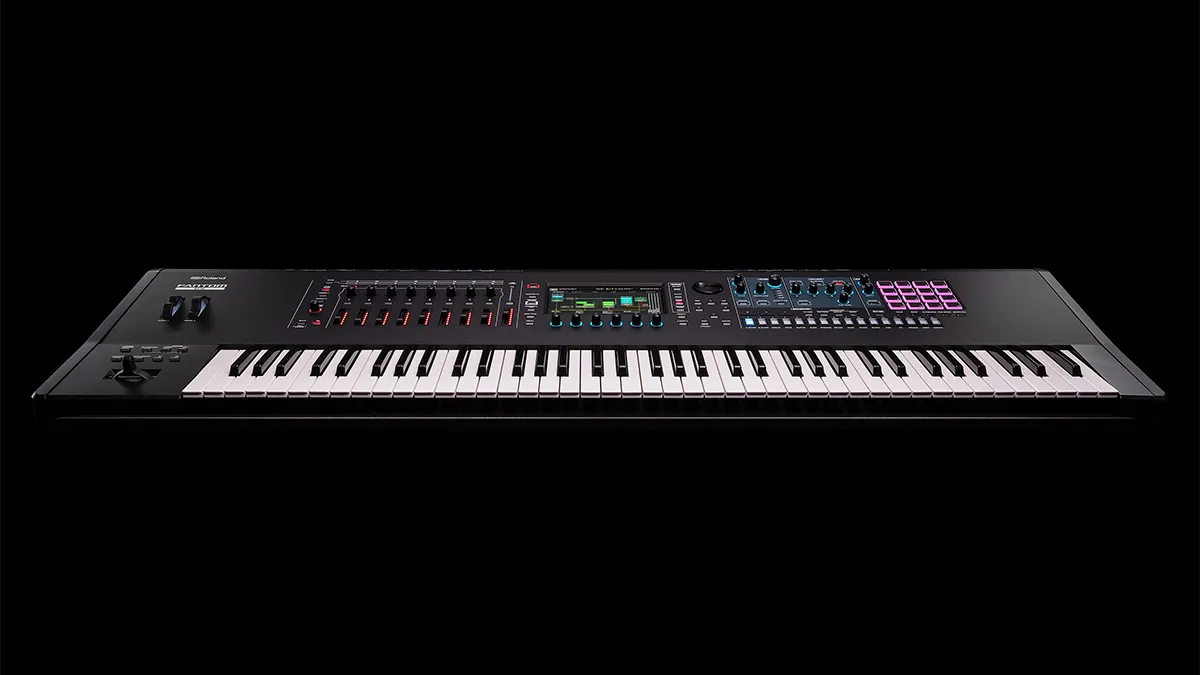
Synthesizer Workstation Korg M3-61| July, 2007Almost 20 years ago, Korg introduced the M1, which was the first music workstation created for the general-interest, average musician. What set the M1 apart from its contemporaries were its sound quality (8-bit!), its 8-track sequencer (with quantizing!), its digital stereo effects, and its sparse, streamlined black case. For a lot of performers, composers, and producers, this was the first synth that gave them everything they needed in one keyboard. The M1 changed our landscape, and paved the way for the Triton series to practically dominate the workstation world beginning in the late ’90s, and for the OASYS to emerge a couple of years ago as the be-all and end-all of high-end synth workstations. So is this more than just an M of a different color? That’s certainly the first thing you notice about the M3: it’s iPod White! Beyond the color scheme, the M3 incorporates a lot of familiar Triton technology, integrates some serious OASYS firepower, and stakes out its own territory in other interesting and useful ways. The Form FactorThe M3 looks different, and it is different. With the exception of the joystick, ribbon controller, and program switches to the left of the keyboard, the controls are all on a front panel that not only can be angled toward you, it can be removed entirely and used as a self-contained module — it’s lightweight, and all the connectors are on the back. In fact, you can buy just that part of the M3 if you like, although the new keyboard action is so good you’d be a fool to miss out on it (see “Gimme Some Action” on page 56). You don’t get a range of viewing angles by adjusting the module position, you just get one, but it’s easy enough to accomplish with the large, finger-tightened screws and folding supports. Removing the module isn’t iPod-easy, but it’s not bad: Just remove the four screws above the keybed (I was wondering what the heck those screws were doing, blemishing an otherwise smooth panel design) and retaining bar, unplug the connector cable, and lift out the module. The module is 26" wide. 7" high, and 3" deep, and weighs about 10 lbs. It contains everything the M3 does, including user samples, which are stored in RAM. So at the end of your gig or rehearsal, you can take the module back to your hotel or home, plug in your cheap MIDI controller, and keep working on your programming and sequencing. Just don’t lose those screws. I bet you’re thinking, “If you can remove the module, can you replace it with something else?” As it happens, there is another module that fits in the keyboard assembly: the RADIAS-R virtual analog synth ($1,499; reviewed Aug. ’06). If you wait a bit and get the 76-key or 88-key version of the M3, the RADIAS-R module can slip in adjacent to the M3 module; no direct integration with the M3, however, in contrast to the EXB-RADIAS, which does integrate. Very cool regardless; we’ll check that out when we get our hands on the bigger versions. Legacies and DeparturesAdopted from the OASYS are eight multifunction sliders, a color touchscreen LCD (Tritons have the same LCD, but monochrome), eight programmable drum pads, and the complete KARMA version 2 engine — a sizable and useful inheritance. Less obvious is what goes on with the sound engine: Essentially putting the OASYS software on a chip, it exhibits smoothness and clarity that definitely raises the sample-playback bar in workstations. Another welcome hand-me-down: the M3’s Combi mode holds up to 16 timbres simultaneously, up from eight in the traditional Triton architecture. The overall structure, look, and feel of the user interface, including the tabbed layout of the touchscreen, will make Triton users feel right at home. However, the similarity is there only to the casual observer, as the synth engine of the M3 has been significantly expanded and improved, much to the delight, we predict, of synthesists everywhere. The changes are much too numerous to detail, but some of the highlights include four-way switching, crossfading, or layering per oscillator (compare that with two-way switching and no crossfading on the Triton); stereo samples available per oscillator (the Triton’s oscillators can handle only mono samples); dual multimode filters per oscillator (up from one, and the filter modes have been improved); envelope generators now have a selectable curves for each segment; dual AMS mixers (AMS is the insanely deep modulation matrix that lets you modulate a modulation by percentages and many other functions, now it’s power is doubled). Yes, there’s more. Yes, it gives you an amazing amount of synth power. Couple that with the beefed-up effects section (170 effects up from a little over 100, with many new, very cool modeling effects), and the result is that the M3 synth engine is likely to keep sound designers and synth addicts happy for a very long time. In some other categories, the M3 leaves the Triton and even the OASYS behind. One is a higher sequencer resolution. Big deal? Yes, especially if you want your recorded MIDI parts to actually reflect the feel of what you performed. The second is in the performance control area: With the touch of a button, that big, juicy touchscreen LCD becomes a KAOSS pad. This lets you do sonic finger-painting by assigning just about any kind of control message to any of the four corners of the LCD, then blend between them by moving your finger around the screen. You can even record moves into the sequencer or into the X-Y pad’s Motion recorder, or transmit your moves via MIDI. The third is the new Drum Track, which unburies the drums from where they usually reside deep in Sequencer Mode and puts ’em on the front panel. Great drum grooves to play along with at the push of a button; totally user-programmable to boot. In fact, any program that you categorize as a drum sound becomes fodder for the drum track; you could have sampled loops, time-sliced samples, bass lines, or anything that will help kick-start your groove for you. The Triton line has always been well supported with new sounds on expansion boards. The M3 currently has only one expansion option, which is a version of Korg’s RADIAS virtual analog synth (See “Extra-Required: RADIAS,” on page 56). A line of USB sound expansion sets is on the drawing board, we’re told. SoundsOverall, the M3’s sound set is aimed at jack-of-all-trades music production. There are many options in all categories, and the new sound engine does make them all sound very good. The keyboard sounds aren’t more numerous than any other category. The acoustic pianos have several rather yummy options: “Stereo 4-Way” sounds like it was miked outside of the case, “Stereo 3-Way” sounds like it was miked from inside, with more key thump. “Stereo 2-Way” is darker, and close-miked. Electric pianos and organs are enhanced by the amp modeling effects in very musical ways. It’s the synths that really shine on the M3, even apart from the sounds on the optional EXB-RADIAS board. I think the new engine is very well suited to synth sounds, and to the filter and time effects that bring them to life. Other standouts are the string, brass, and saxophone sounds, all of which are a cut above what I’ve come to expect in a sample-playback instrument. They’re programmed to yield very musical results. The drums — when has Korg not had killer drums? — are deep. From orchestral and ethnic percussion to wild distorted kits, you won’t lack for anything in the drum department. Factor in the bank of GM sounds, and you’re biggest problem is going to be option anxiety. In UseWithin minutes of powering up the M3 for the first time, I was totally inspired by the integration of the internal sounds with the Drum Track, KARMA, and the X-Y LCD pad. As I scrolled through the first bank of Programs and Combis, I felt like I was ready to lay down some tracks. It turns out that I have a pressing need for a lot of short tracks to use as a bed for pre-roll IDs for the videos we produce for KeyboardMag.TV, our video site. We crank out dozens of new clips each week, and one little intro tune doesn’t begin to suit the mood of every clip. So I gave myself a tough but rather real-world goal: three 30-second ID tracks, within three hours. Tougher still was the fact that while I am familiar with the Triton system, I was brand-new to the M3. I wanted to see how much I could get out of the M3 using just a single sound in Program mode, one multitimbral setup in Combi mode, and one from-the-ground-up song in Sequence mode, using the Drum Tack, KARMA, and the X-Y pad as much as possible. I dialed up a Program on the optional EXB-RADIAS board called “Psy Zoop.” Using the Modulation Sequencing on the RADIAS board to control the filter, this Program sounds like a funky, one-key electronic drum kit all by itself. I turned on KARMA, which had an insane gated effect. Then I turned on the Drum Track, and was blown away. I wanted to personalize the KARMA effect a bit, so I put the sliders in KARMA mode and started tweaking the default parameters, which happened to be rhythm and duration of the gate effect. After a bit of moving the sliders up and down, I had what I wanted. I pressed the button combination that automatically sets up a Sequence using your current Program or Combi settings (called Auto Song Setup, this feature is great, but I wish it had its own dedicated button), and was ready to push record. In one pass, I let the synth part play for a couple of bars, then added the KARMA effect, then the drums, for a total of 16 bars. To save my tune, I pushed the Media Mode button, chose the “Save All” option, and waited about 20 seconds for the song to save to my USB drive — I found later that I could’ve skipped the “save all” part and saved it instantly. Time elapsed from idea to finished track: About 10 minutes. To my amazement, I had all three tracks completed and saved as WAV files in about 45 minutes. The Drum Track and KARMA effects let me dial in parts that were grooving and interesting, even when I took the time to change the drum sounds or drum patterns. On my full-on sequenced tune, I played in all the parts in a straight-eighths rhythm. I wanted to make it a little looser, and dialed in the variable swing to give each track a cool feel. I could vary the swing on a per-track and per-note basis, getting a slightly laid back feel, or an extreme crisp dotted-eighth, sixteenth rhythm, or go beyond that. I took another minute to set up a cool oscillator fade on one part via the X-Y pad, which couldn’t have been easier. I even recorded an audio track using the Sample-in-Track feature; it took all of five minutes to set up the signal routing and mic level, then another minute to figure out I’d set the sample trigger mode incorrectly. Once I had it dialed in, I recorded my vocal in one pass. Then I set up an insert effect for the vocal and routed the audio through it. For a workstation that claims not to have an audio multitrack onboard, the M3 sure records a lotta audio — though to be clear, you can’t edit the audio in the Sequencer mode. Other than just pasting the sample again in Sequencer mode, you have to edit audio as an individual sample in Sampler mode. Since audio is recorded with bars and beats timing info, you can make edits that match the tempo of your tune; you just can’t listen to the tune while you make the edits. I do wish the M3 had an internal hard drive or CD-R burner. Not being able to automatically save a Sequence or Sample to an internal location makes me nervous, even though I know Korg workstations haven’t had that feature since the M1. It’s not difficult to save your Programs, Combis, or Sequences in general, but it takes longer than I’d like to save a Sequence with lots of in-track sampling; I wish there was some one-button way to save my creation, no matter what is in it, much like the way the Auto Song Setup gets me started. The M3 is equipped with two USB2 host ports, and unfortunately I found that the M3 couldn’t see my crappy old CD-R/W drive; it did work with a USB 1.1 hard drive I found in my outdated pile of computer junk. USB2 makes a lot of sense, as peripherals with that connectivity are really affordable these days; in some cases they’re free in the form of promotional USB memory sticks. Keep in mind that the M3 may have to format the drive you attach to it; don’t expect to just add your M3 tracks to whatever you’re saving on your backup drive. I used the M3’s USB2 client port to connect to my Mac, on which I installed the M3 Editor/Librarian software that comes with the instrument. This makes it easy to rearrange banks and manage large numbers of edited programs, for sure. But to be honest, I find it just as easy to do my actual editing on the M3 itself. There is a FireWire expansion option that was not available by press time, so I didn’t get to check out how the M3 can pass audio directly to a host sequencer as well as MIDI; the M3 editor appears as a plug-in instrument in software DAWs via USB, but handles parameter control only, no audio is generated from within your DAW. We’ll check out the FireWire option when we get our hands on the 76- or 88-key M3. ConclusionsThere’s never enough time or space to give a Korg workstation the thorough discussion it deserves, and this is no exception. With the M3-61, Korg zeroes in on the perfect workstation. The keys are the best ever. The modular design is design is a step towards making it easier to take synth, sampling, and sequencer work home from the “office.” The Drum Track and KARMA 2 functions are not only inspiring, they help speed up the production process. The sliders and X-Y pad give the M3 a degree of realtime mojo that the Tritons didn’t often have. The new sound engine is much more powerful than the Triton, it gives more air to the sound, and makes for smoother effects and filters. Just about everything that was right about the Triton has been incorporated. Price doesn’t seem to be a breakthrough on this new line. But then, it’s not inconsistent with what it’s taken to get your hands on a Triton in the past. Considering the huge improvement to the synth engine, it’s definitely not out of line. On my wish list: I wish it was easier to remove and replace the module; I’ll stop short of asking for a battery power option, though! XLR audio inputs with phantom power would be a big help for anyone wanting to use the sampling features. Not being able to load Triton data is kind of a drag, but given that the synth engine has been substantially improved it’s not unexpected. Some internal storage would be a nice convenience. Yamaha’s Motif and Roland’s Fantom workstations offer similar feature sets at similar prices; the Alesis Fusion is a budget option by comparison. At press time, we had not received a Yamaha Motif XS, so we can’t offer a head-to-head comparison yet. The Roland Fantom has some great features that help with song creation, such as the Skip Back Sampling feature that keeps track of all your noodling and a user interface that’s very easy to navigate. It really does come down to sound and interface; spend as much time as you can with all of these, if this is your first workstation purchase. For you pros, you’ve got a simpler problem: How much gear are you going to have to sell before you can get your own M3? You’re going to want one. vital statsSYNTHESIS TYPE: POLYPHONY: MULTITIMBRAL PARTS: WAVEFORM ROM: SAMPLE RAM: SAMPLING RESOLUTION: DISPLAY: CONTROLLERS: AUDIO I/O: MIDI CONNECTORS: USB: DIMENSIONS/WEIGHT: OPTIONAL ACCESSORIES: GORY DETAILSSAMPLE FORMATS: SAMPLE EDITING: EFFECTS: KARMA: KARMA Generated effects: DRUM TRACK: SEQUENCER: Extra-Required: EXB-RADIASKorg won’t claim that the optional EXB-RADIAS expansion board is required for the M3. But I will. True, the EXB-RADIAS won’t read program data from the full RADIAS. True, it doesn’t have an independent arpeggiator. True, it doesn’t come with its own bank of Combis, just its own bank of Programs. GIMME SOME ACTIONKorg designed and manufactured the new weighted synth-action keyboard that you’ll find on the 61- and 76-key versions of the M3. I’ll cut to the chase: This is the best synth action keyboard I’ve ever played. It feels substantial but not stiff. The black keys are slightly matte-textured, not so much so that my fingers grip the surface, but enough to lessen the likelihood that they would slide off inadvertently. The aftertouch implementation is superb: it feels as though the aftertouch range is a totally separate area of the key throw. Even when playing my hardest, I was unable to trigger the aftertouch accidentally. But when I wanted it, just a little bit of weight from my shoulder opened up a new range of key motion into the keybed. How smooth is the motion? I checked the event list in my software sequencer after I recorded a long, slow lean into the keybed, and I found the M3’s new keyboard transmits aftertouch values between 0 and 127 in single-digit increments. Yes, that means it went through every one of those 128 values as I gradually pressed harder. With a little practice and with aftertouch routed to pitch, you can play a scale (major, minor, diminished, whatever you can hear), in tune, by doing nothing more than adding pressure on a key. This is an extraordinary amount of control, and it’s enhanced by the M3’s eight aftertouch curves (included with the Triton series for ages), which let you dial in which end of the aftertouch range is easier to make small changes to, or scale the output so you get quarter-tones or half-steps, or even generate random values. The keyboard performed great when I used it to create the audio examples of the Garritan Stradivari Violin and Gofriller Cello at www.keyboardmag.com/0607126. Finally, a synth workstation with a keyboard that makes aftertouch as useful a programming and performance tool as a joystick. Major kudos to Korg for this. CLAIM CHECKJerry Kovarsky, Product Development Manager for Korg USA, says, “With the M3 we set out to take the concept of the music workstation to the next level from our previous instruments and others in the marketplace. We delivered a lot of innovations in the OASYS and all along we were planning a parallel chip-based platform, so the M3 benefits from a lot of that development. Sound is always of paramount importance, and the new EDS engine delivers a higher level of fidelity and synthesis possibilities when compared to our previous mid-priced offerings. Control and expressivity have been taken to a new level with our newly designed keybed, control surface, drum pads, and the unique touchscreen KAOSS mode. We recognized the need for better integration with computer DAWs, so we enhanced the concept of a plug-in editor with our new FireWire option, providing one-cable connectivity of audio and MIDI within your favorite application. Finally, we provided configuration flexibility with our Korg Komponent System, allowing the user to tailor their setup to meet their needs. The M3 is aimed at all serious musicians who desire an expressive instrument and platform for creating great music.” |
Keyboard Magazine is part of the Music Player Network.