Main Site Navigation

KeyboardMag.com >> This Month >> Key Hits
Images
External Weblinks

Key Hits

| February, 2008

Bringing classical piano training and synth savvy to his production game, J.R. Rotem creates pop and hip-hop platinum.

Jonathan “J.R.” Rotem works in his Los Angeles studio surrounded by a rack full of keyboards and walls covered with platinum records. And if recent history is any indication, he’ll continue to have trophies to hang for years to come; created with singer Sean Kingston, who Rotem signed to his label Beluga Heights, the song “Beautiful Girls” spent four consecutive weeks in the top spot of Billboard’s Top 100. Another sign of Rotem’s widespread success is on display in the foyer — a platinum ring tone plaque on the wall, complete with a platinum cell phone and seven-figure sales numbers. Having worked with everyone from Destiny’s Child to Britney Spears, Dr. Dre to Snoop Dogg, Rotem has established himself among the pop, hip-hop, and R&B production elite, though he has a background most of his contemporaries can’t claim: a youth spent in serious classical piano training.

Rotem was born in South Africa, grew up in Canada, and came of age in Northern California. He studied classical piano starting from age five, playing regularly in competitions and recitals. He concentrated on learning Chopin, Bach, Beethoven, Mozart, and Tchaikovsky; however, during that time, he became a fan of pop music and hip-hop, influences that would plant the seeds for his future career. When asked of his biggest classical influences, Rotem cites the masters, mentioning Bach, Stravinsky, and the Russian romantic and contemporary composers. But how did the promising young classical pianist make the transition to hip-hop and pop? Rotem recently unfolded the story for us in his Hollywood studio.

The Road to Production

“I came from a family that was very musical, but they were more into classical and jazz, obviously not so much hip-hop,” says Rotem. “And I didn’t grow up in Los Angeles or New York. I didn’t really have people around me that listened to it. But there was something — I was just very drawn to it. At first, when I was young hearing Run DMC’s ‘Raising Hell,’ never did I think I would have anything to do with that sort of music. It was more in ’93 when I heard Snoop Dogg and Dr. Dre, when the beats started to get more musical. I was like ‘Whoa, I really like the music going on here,’ and not just the rapping. But still at that point, I didn’t see how I would be involved.”

Once Rotem began attending Berklee College of Music in Boston, he discovered jazz. His original plan was to learn film scoring and he already had a grasp of the compositional process and the craft of MIDI sequencing. However, jazz took hold of him. “I became so immersed in the world of jazz that I forgot about the film scoring thing. I started practicing 12 hours a day to learn the art,” he says.

Rotem absorbed music from Miles Davis, John Coltrane, and many influential jazz pianists, but one in particular set him off: “The pianist that was the most shocking to me was McCoy Tyner and his use of fourths,” he says. “I had never heard music like that and that just became the most important thing to me. So in the course of being in Berklee, I transitioned into becoming a jazz pianist.”

Even as he studied jazz, Rotem remained a loyal fan of hip-hop, adding songs from that genre to the jazz performances for which he would subsequently become known in the Bay Area scene, post-Berklee. When he started producing, he relied on his own performance skills to perform tracks and thought he’d never have a reason to sample. But as it turns out, two of his biggest hits — “S.O.S.” by Rhianna and “Beautiful Girls” by Sean Kingston — are both based on prominent samples. So what does Rotem think about sampling now? 

“When I made the transition to truly being a producer, which to me means giving the artist, label, and public a hit record, I started thinking less from the ego standpoint of, ‘I have to compose it and I have to play it. Let me show you my chops on keyboard!’” he says. “It was more like, ‘Okay, what would make for the ultimate hit?’” Rotem replayed the keyboard hook on “S.O.S.” himself using a Roland Juno-60, rather than keeping the original, however.

The Producer’s Rig

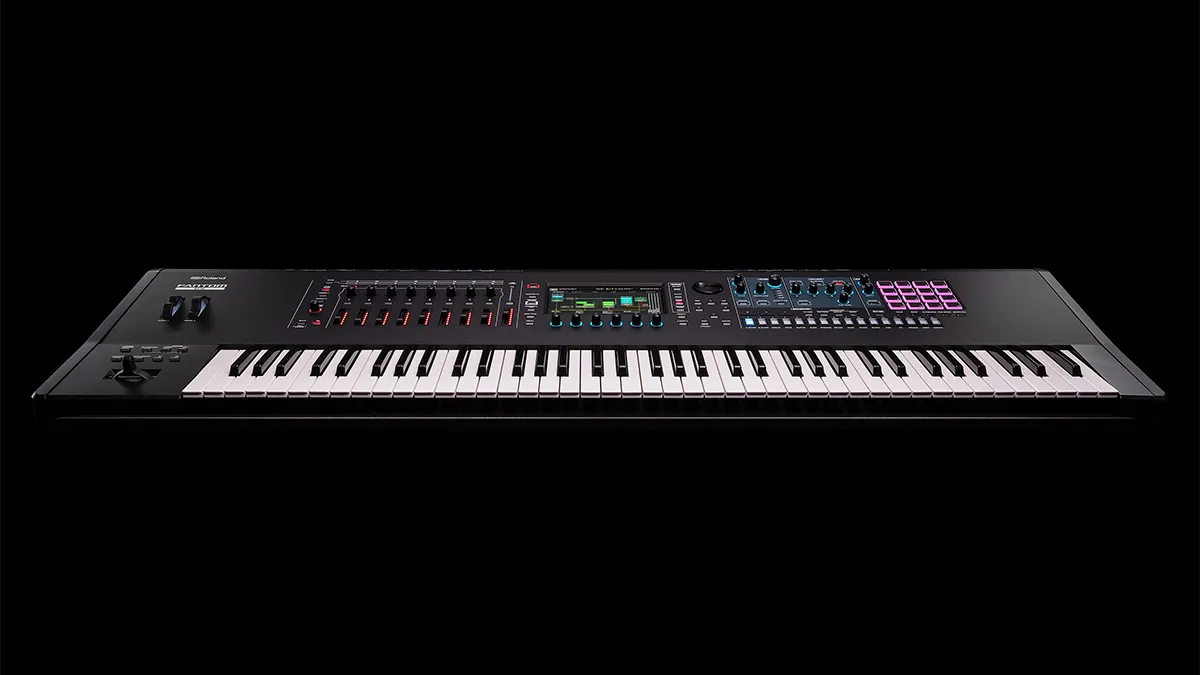
In his studio, Rotem relies heavily on an arsenal of keyboards that flanks him at his mixing desk. These include a Yamaha Motif XS8, Korg Triton and Radius, a Roland Fantom-XR and V-Synth, and an Akai MPC2500, plus a host of rack-mounted gear. Most of the sounds he uses come directly from the keyboards rather than soft synths. “I’m just more comfortable on keyboards,” Rotem says. “I like scrolling through the sounds. They’re not buggy. Coming from the jazz world and classical piano, I can still feel the latency on soft synths, even though it’s small.” Rotem’s operation isn’t hardware only, though. “I might start getting inspired playing,” he says. “I’ll pull up a piano sound and if it’s a pop ballad with a very exposed piano, I might then either layer or replace the sound with a soft synth.”

The Yamaha Motif is Rotem’s main production axe, though he has logged many years as a Korg Triton devotee. “One of the most important things I learned from production is to not have all your sounds come from one keyboard,” he says. “One of the ways to get things to sound big is to combine sources. Yamaha has a certain kind of texture to it, Korg has a different one, Roland has another one. I never like to have everything come from one keyboard. However, having said that, I would say that [the Motif] has a lot of stuff. The pianos are incredibly realistic. The electric pianos are great. The organs are amazing. It has a lot of synth-type sounds that I use that I can’t find in other things. One of the patches from the Motif that I can’t beat it is called Sweet Flute. It’s an amazing sound.”

Though Rotem likes the breadth and realism of the Motif, he sometimes prefers the Triton’s digital edge. “It’s got wilder sounds to it, especially in the percussion,” says Rotem. “I like a lot of the string sounds in it.”

How does the producer begin using his tools to build a hit? “I’ll start stacking the beat,” he begins. “Again, one sound from every keyboard — a four- or eight-bar loop or something similar. Then once I have the meat and potatoes of it there in MIDI, I track it all into audio. So now I have four- or eight-bar audio loops. I put plug-ins on them so I’m sort of mixing as I go. Then I cut and paste, and start adding more layers to it, which usually I do in MIDI for the purpose of being able to edit or quantize first. I then immediately bounce everything into audio. I don’t just do it in MIDI and then call up the sounds.”

For making beats, Rotem uses a classic MPC2500 sampler, but not as the brains of his operation. “The majority of hip-hop and R&B producers use this as the centerpiece of everything,” he says. “They sequence MIDI through it, they sample all their drum sounds, and all that kind of stuff. For me, I treat it as basically a drum module. The type of drum sounds that you can get from keyboards — there’s a limit. They’re going to end up sounding cheesy if you rely only on them.” Rotem appreciates the ability to trade sounds and tweak samples, and has his MPC hooked up via MIDI to his keyboards, through which he does all his sequencing in Pro Tools. “I’ll sequence stuff in Pro Tools in MIDI and then record it into audio,” he says. “I don’t even play the MPC’s drum sounds off the pads. I’ll play off the keyboard. I’ve always been a lot more comfortable that way.”

What roles do Rotem’s other axes play in the production process? “This is a really cool keyboard,” he says, referring to his Korg Radius. “Before this, I used the Korg MS2000, which I still have. I was looking for a wild keyboard to give me more analog stuff, very edgy, techno-y sounds and arpeggiation — things like that. To be honest with you, I probably don’t tap into a fraction of what these keyboards can do, especially a keyboard that’s this tweakable. I love a lot of the presets on it. There’s this one sound — I have to admit one of the songs of recent times that really influenced me was Justin Timberlake’s ‘My Love.’ So I found [the synth sound featured on that song] on here. I probably use it way too much. It’s called Visualizer. I use it for leads, basses, and things like that.”

Rotem also recently purchased a Roland V-Synth GT in a quest for new sounds. “For me, new patches are just essential to be inspired when making new tracks,” he says. “I’ve always needed a steady supply of new sounds, because that’s probably the most inspirational thing for me when I compose. So I listened to this and there’s just no keyboard like it. The sounds are very complex and textured.” Rotem also finds the Fantom-XR to be indispensable, using it mainly for pianos and lead sounds. “It’s like the Motif and the Triton. It’s an everything kind of module. But again, it’s very important for me to use sounds from different manufacturers.” For realistic Mellotron sounds, Rotem uses the GForce M-Tron soft synth; he also utilizes Synthogy Ivory when he needs a realistic piano sound. “Sometimes it’s even a little too realistic,” he says. “In certain kinds of productions, that kind of realism doesn’t blend well, but in times when the piano really needs to be exposed and you want it to sound real, Ivory is pretty incredible.”  Despite his heavy rig, Rotem leans acoustic as well; he has a Yamaha C2 in his apartment to keep his chops up and to help him unwind.

Navigating the Business

Though J.R. is into making records, he realizes how strongly the market is currently geared towards singles. “These days, the whole way people are buying and listening to music — and even recording music — is completely different,” he says. “People’s attention spans are not what they were. Before, I remember buying an album, putting on headphones, zoning out for an hour — it was a day experience. Now, kids can just flip from one song to the next with iTunes. It’s definitely a singles game.” And it’s a game he plays better than most. “Nowadays, to be truthful with you, I’m not too excited about any song that doesn’t become a single because people are buying a lot less albums. So the album cuts and the continuity have become less and less important. Obviously, CDs are going to become extinct like cassette tapes are. The format is going to be files. It just makes more sense.”

Even so, Rotem holds out hope for the album’s survival as an artistic format. “I hope that it does endure, because the albums that I like, even as a producer, are the ones that have continuity,” he says. “For instance, Quincy Jones doing all of Thriller or George Martin producing an entire Beatles album. I love that. That’s why the type of artists that I sign to my label, like Sean Kingston — I wasn’t interested in making a lot of money off him, or producing just two songs on the album and delegating the rest of it to other people. For me, it was like, ‘I love this, I’m inspired by it, and I’m doing the entire album.’ So I love the concept of the cohesive album. There are intros on [Sean Kingston’s] album and continuity. Is it as appreciated as it would have been ten years ago? No. It’s tough to know where it’s going to go.”

Other Gigs

It wasn’t so long ago that Rotem played piano for a living, albeit a meager one. Years ago before he was a producer, he played at a Nordstrom’s, which taught him a lesson or two in humility. “That was really not a fun gig,” he says. “I had to wear a tuxedo. I had to play there for very low pay. The thing that was the most morally humiliating — I’m a very creative person, and they obviously want you to play at a very low volume level. Not even just volume, but the type of chords that you use. It’s a very corporate kind of environment. I would have a crowd of people around me listening, but my manager would tell me, ‘You really need to tone it down.’ So it squashes your creativity. I understand where they’re coming from. They’re hiring you for an ambiance and not necessarily for the art of it. But for me, that was tough.” Rotem also had a stint playing piano on a Carnival cruise line right out of Berklee. “That really sucked,” he says. “I thought, ‘I’m going to get on a cruise ship and I’m going to get good food and all this stuff,’ but they treat the musicians like third-class citizens. You’re playing very bad versions of Broadway shows and things like that. That was not a fun gig.”

Luckily for Rotem, his current gig is not just fun but creatively fulfilling. As Rotem puts it, “I’m very blessed, to be honest with you. When I look at my life, there isn’t anything that I’d rather be doing. I just want to continue doing what I’m doing, and get better at it. It’s an infinite craft and art, making hits. I love coming in here every day and creating.”

A Selected J.R. Rotem Production Discography

Sean Kingston, Sean Kingston (Beluga Heights/ Epic); full album
50 Cent, Massacre (G-Unit/ Interscope); “So Amazing”, “Position of Power”
Destiny’s Child, Survivor (Columbia); “Fancy”
The Game, Doctor’s Advocate (Aftermath); “Doctor’s Advocate”, “West Coast”
Snoop Dogg, R&G (Geffen); “Bang Out”
Jojo, The High Road (Universal); “The High Road”


Keyboard Magazine is part of the Music Player Network.