If anyone says that prog is passé, don’t believe it. New players have
emerged from every decade since the heyday of Yes, ELP, King Crimson,
and early Genesis. One of the most prolific is Erik Norlander. Beginning
in 1999 with his first solo album and continuing through his work with
the Rocket Scientists, Lana Lane, Asia featuring John Payne, and Ayreon
(among others), Norlander most recently released a pair of albums—Definitive Edition and Live in Gettysburg—with
his latest band, the Galactic Collective. He was also instrumental (pun
intended) in the design of Alesis’ now-coveted polyphonic analog synth,
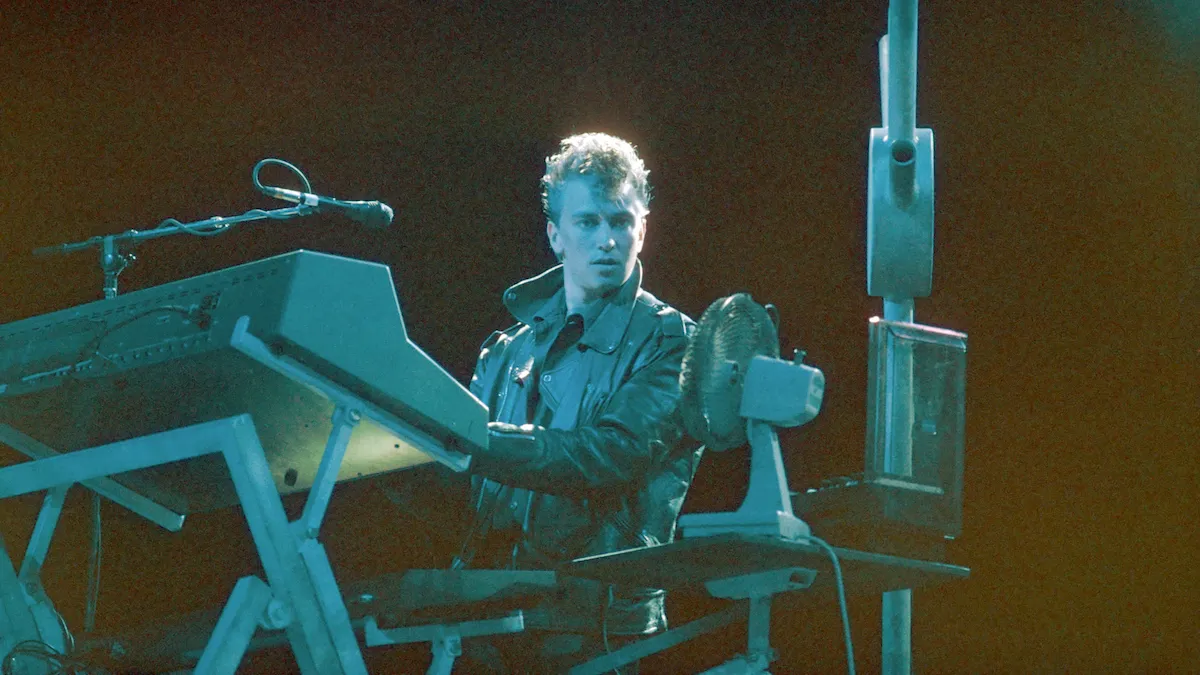
the Andromeda. (Click image below for super-sized version.)
Who has had the most impact on your playing?
Keith Emerson and Rick Wakeman were prime influences on me
as a developing player, and I’ve gotten to know them both over the past
15 years. I don’t think you can play rock Hammond organ properly
without studying Jon Lord. I should also mention Patrick Moraz and Eddie
Jobson. Patrick is just a phenomenal player and a wonderful human
being. Jordan Rudess is a phenomenal player and another great guy. Derek
Sherinian is wonderful. Jens Johansson in Sweden—he kind of started the
keyboardist-in-a-prog-metal-band role.
When you record, what instruments do you play the most?
The Minimoog D is the absolute standard. I also love the
Moog Voyager; it’s different from the Model D, and gets a lot of sounds
it that the ’70s Minimoog can’t get. The Andromeda is a go-to
instrument. When we were designing it, I pushed hard for certain things,
like the sub-oscillators and the two filters: an Oberheim SEM-style
state-variable filter and a Moog-style four-pole lowpass filter.
On the current side, the Yamaha Motif XS and XF are really the summit of
sample-playback synthesis. They have great-sounding filters and effects
and all the modulation routings you need.
Your modular synth, the “Wall of Doom,” is almost certainly the largest ever to hit the road. How did you acquire it?
In the mid-’90s I had Keith Emerson’s famous Moog modular
on loan for about a month, to make samples for the Alesis QS series. I
needed the best analog synth samples I could get, so I went right to the
top. I called Keith and said, “Hey, could I borrow your modular?” I
thought, “This is hands-down the best-sounding synth I’ve ever heard,
and I have to get one.” I finally found a very early Moog IIc
system in Los Angeles. It needed a lot of work. I bought it for about
the price of a good used car and sent it out for restoration. Over the
next few years, I found various modules and a couple of small systems
that I assimilated into it. It became truly operational in 1999 with the
help of some engineer friends, notably Kevin Lightner and Julie
Yarborough.
What can you tell us about your connection to Bob Moog and the Bob Moog Foundation?
I first met Bob at Winter NAMM 1997. I had a green light
to build the Alesis Andromeda and needed an electrical engineer. That
didn’t work out because Bob was already working on a top-secret
instrument that later turned into the Minimoog Voyager. In 2007, I was
invited to play MoogFest in New York City. The first person I met when I
got there was Michelle, Bob’s daughter. I learned about what she was
doing with the Bob Moog Foundation, so I volunteered. When MoogFest
relocated to Asheville, North Carolina [home of both the Moog Music
company and the non-profit Bob Moog Foundation], I participated in a
panel about modular synthesizers. I brought the Wall of Doom out for
that. I’m a big believer in the cause. The Bob Moog Foundation can use
me for anything!
What kind of studio do you have at home?
It’s a Mac-based studio running MOTU Digital Performer.
It’s a fairly big room to fit the Wall of Doom, my Hammond and grand
piano, all of that. I dabble in Logic and Pro Tools from time to time,
depending on the project. I just recently got a Universal Audio Apollo,
which I just love.
What can you tell us about your Hammond organ?
I have this Model D from 1939. This pre-dates the B-3 and
C-3. It also pre-dates the Hammond percussion system, so I had an
aftermarket Trek II installed. Accutronics has a spring reverb tank that
I put in it. A company called Hampton has a preamp they made especially
for Hammond organs that gives you plus or minus 12dB of treble and bass
shelving EQ along with 12dB of gain. Just with that little preamp and
the tube output of the Hammond itself, I can get a really nice, warm
overdrive.
How did the Galactic Collective come together?
The guitarist is Freddy DeMarco, the bass player is Mark
Matthews, and the drummer is Nick LePar. They’re all from the Akron,
Ohio, area. I’d been working with a wonderful concert promoter named
Dena Henry. We’d have to fly out four or five people and put them up in
hotels just to play some club dates. We found ourselves turning down a
lot of dates because it was just too expensive. So Dena said, “You know,
there are a lot of incredible musicians here in Ohio you should get to
know, especially for your solo projects.” That’s how I got to work with
these three guys.
What’s in your immediate future?
A new solo album of original music, and an album with my
wife Lana Lane—her tenth. Aside from that, I’m always looking for new
musical opportunities.