How did the two of you divide the labor?
Michael Leonhart: The rhythm arrangements were
done, but once we had the drums recorded, we were like, “Okay, if this
is what it sounds like now, maybe that bass line doesn’t need as many
notes” or, “Maybe that guitar part should go like this instead.”
DF: I may have little ideas for things, but
generally speaking, I do horn arrangements after the fact. Once the
track is done, that’s also when I start getting ideas for vocal
backgrounds.
The record is full of Rhodes, Wurly, and Clav, as well
Minimoog, Prophet-5, and melodica. What is it about those that still
intrigues you?
DF: I like keyboards that sound natural. A lot of
it has to do with the fact that I don’t like the tuning of synthesizers.
A tempered keyboard without stretch tuning makes for problems. The
higher you go, the flatter the note becomes, and the lower you go, the
sharper it becomes. And even synthesizers that do have some type of
stretch tuning still have some peculiar harmonics that don’t sound right
to me. So I like tunable keyboards. I love Clavinet. It’s just funky.
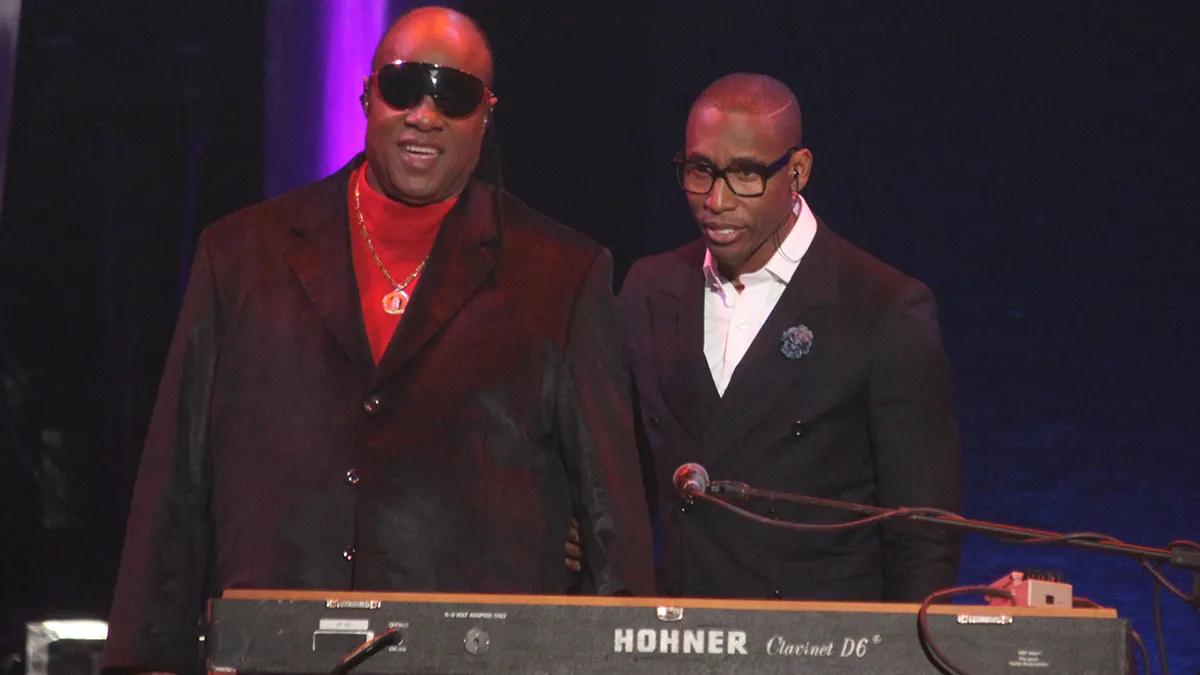
ML: We also happened to find a Clavinet that actually stayed in tune. It was a Hohner E7.
You’ve talked in the past about using synths to bring out aspects of other instrument parts. Can you speak to that?
DF: They’re good for little ornaments, or to
thicken things. But I remember when we used to use synthesizers more on
different Steely Dan records—like if we were using a high, celeste-type
part, we’d have to sharpen it just a little bit. We always had to dick
around with the tuning. Some people like the sound of synthesizers, even
with their peculiar tuning, because they sound funny or ironic to them.
But I’m not really into it. That’s Ennio Morricone-ville.
Were any instruments on this record new to you and therefore enjoyable to use?
ML: Because of the way we recorded, we had the
luxury of time to make the process as comfortable as possible. In some
cases, like when the tuning was off with our Prophet-5, we were able to
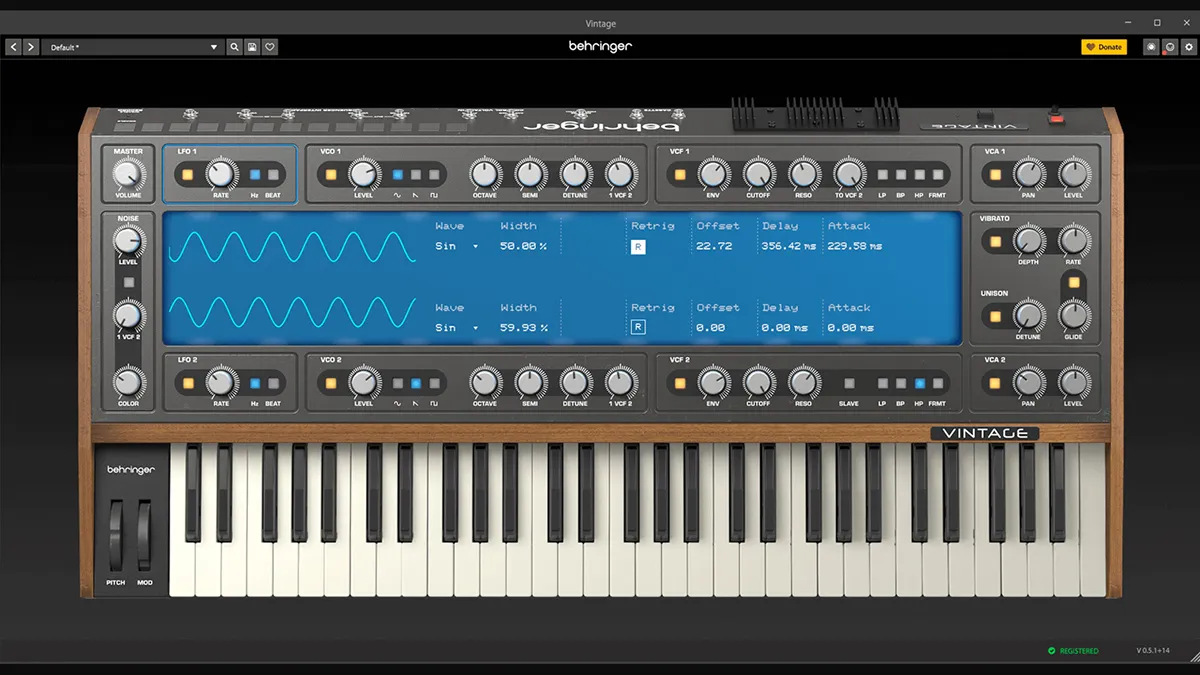
compare the virtual version from the Arturia V-Collection with the real
thing and pick the one we liked better. So it was the best of both
worlds.
DF: Michael also has this weird half-sized Japanese vibraphone. It’s really cool sounding.
What’s your preferred instrument for composing?
DF: I always write on a Yamaha upright piano. When I
want to get more into the arranging side of things, I make little demos
on [Apple] GarageBand.
“Slinky Thing” has a Clav-driven funk groove, but you
expand on it with shifting chord movement. You seem to be saying, “The
song has to feel good, but it also has to go somewhere.”
DF: That’s exactly right. I’m just easily bored.
ML: We talked about Igor Stravinsky in this way a
number of times—how the magic with him is that you never get bored. His
music is always exciting and moving. One of the things that struck me
the first time I heard “Slinky Thing” was the end section. Lyrically,
it’s almost like another song. You don’t see that coming, and that’s
what makes it special.
DF: I thought that song needed a kind of coda to comment on the front section.
There’s a sneaky, almost vocal-like synth sound on the intro that answers the Clav. What is that?
DF: It’s a f***ed-up GarageBand sound that we ended
up keeping from the demo. I think it was some kind of marimba. I liked
how the decay on it dipped in pitch.
ML: I actually played the same part later on the
Prophet-5 and asked Donald if he wanted to replace it. But we both
agreed the sound on the demo was better.
Most breakup songs are about how one person can’t live
without the other. But in “I’m Not the Same Without You,” the narrator
feels downright superhuman about it. . . .
DF: That song is really a takeoff on certain songs,
like “I Will Survive,” where the person says, “I’m devastated by this
breakup, but I’m gonna keep a stiff upper lip and get through it.” I
thought it’d be funny if you extrapolated from that idea, so that the
person actually starts to mutate into something that’s not quite human.
Although, it’s supposed to make the listener wonder if in fact the guy was so devastated that he’s become somewhat psychotic. [Laughs.] It’s the “unreliable narrator” device.
That song has a series of descending ii-V changes on the lyrics, “bright arcades in which I bring off heroic escapades.”
DF: I still like the cycle of fifths. The composer
Bob Telson once gave me a long disquisition on how much he hated it, but
I still find it useful once in a while. I mean, it worked for Bach.
But isn’t more innovative, unusual harmonic motion a Fagen and Steely Dan hallmark?
DF: It’s really not a matter of wanting to
innovate. It’s a matter of trying to not fall asleep. When you’re making
a record, you have to listen to these things hundreds or thousands of
times. It’s like how sometimes you’ll see a film with scenes that are so
slow you can hardly pay attention. I always think of directors who had
to edit films on a Moviola, staring at those scenes hundreds of times. I
wonder, “How can you even stand it?”
ML: You don’t shoot for innovation—you just try not to be boring.
DF: I have to tell you, it’s really just to
entertain myself. I think Walter Becker would agree. We always felt a
little deficient for not being innovators, in our own minds at least. We
loved certain traditions in jazz and R&B, and we used those as our
foundation. That’s what gives the music soul. Maybe what we tried to do was combine some
things that weren’t usually combined. But we never thought of ourselves
as innovative. I find that 95 percent of what people call “innovative”
or “experimental” is just pure B.S. Most such things are forgotten a
year later, because it’s often just someone being self-conscious in an
attempt to be different. And it usually ends up being really bad.
Is it fair to say that much of your work evinces classical music, where melodic motifs are played, then inverted, then transposed, and otherwise put through their paces?
DF: Yeah. You want to get out of the key and do something
so you’re not just sitting there listening to a static piece of music.
That’s not to say I don’t like the blues, because I do. But you do want to hear some development.
ML: One time when we were overdubbing organ parts
for “Memorabilia” at my studio, I played something I thought was cool,
and Donald said, “No! No footballs.”
DF: Meaning, a whole-note pad.
ML: Something clicked and I got it. In the
architecture of the song and the arrangement, if you start adding these
big footballs of keyboards or guitars or horns, it eats up all the
space.
DF: There’s no air, you know? Then you end up with rock ’n’ roll.
ML: That’s a classical and a Stravinsky concept—this idea of sculpting space for things to shine through.
DF: Stravinsky is all about air—that’s why even if he uses a very large orchestra, it never sounds too heavy.
The drum tracks are credited to “Earl Cooke Jr.,” which
is actually an alias for Michael Leonhart himself. How did the
trumpeter become the drummer as well?
DF: Sometimes when Michael and I were on the road,
I’d hear him get behind the drums during sound check and would think,
“Wow, that’s funky.” So when we first started working on the album, I
said to him, “You have drums set up at your place. Why don’t you just
play to the first couple of demos?” And they came out great. So since
this particular album has more dancey kinds of grooves and didn’t
require tremendous technique on the drums, I told him to keep on
playing. At that point, Mike was like, “Okay, we’ll do some like this,
but we’ll call in [Steely Dan drummer] Keith Carlock on some others,”
but we just kept going and Mike ended up doing all of them.
ML: I always thought we’d bring in four or five
drummers. Maybe it’s because I didn’t put a lot of pressure on the
situation that I didn’t suffocate the music. I just played on some
demos, and all of a sudden, we had nine finished tracks.
DF: He had an old-school groove, maybe from being a
jazz player. It was just a really comfortable groove that was exactly
what the music needed.
The harmonica is a sound you return to again and again. What about it still captivates you?
DF: Well, I always liked Toots Thielmans and I loved Stevie Wonder’s playing. I like the harmonica because it’s light
and it can float over a groove. There’s something very poignant and
childlike about it. Plus I got tired of those same saxophone solos. I
wish I could play the harmonica. That’s why I play the melodica, but
it’s not as expressive. So I hire harmonica players.
“Memorabilia” seems to have it all: a monster groove, shifting harmonies, and a startling story. What was its story?
DF: Because both Walter and I grew up in the Cold
War era, the threat of nuclear holocaust was an everyday thing. It was
always being thrown at kids, with “duck and cover” and civil defense
drills. Kids in the 1950s—if they were paying attention—sort of took
atomic catastrophe as a given. As a kid, I’d heard a story about
this one island in the Pacific. The bomb they were testing turned out to
be stronger than they thought and it just disintegrated the whole
island. So I invented this girl named Ivy King, who’s actually named
after one of the tests. Ivy collects memorabilia from nuclear tests, and
this guy Louie Dakine is a sort of fence for it. Ivy goes to his back
room and looks through all his stuff. That’s what the song is about.
I think I got the idea from the late friend of my wife. He
was a famous sculptor. He lived near Los Alamos and would actually make
sculptures out of atomic-era trash he found in the desert, including
musical instruments. He once made this huge set of chimes.
What’s the Theremin-like sound that comes in on the second verse?
ML: That’s a Hammond L-100 organ that I got for 99
bucks! I’ve always thought that organ is kind of Garth Hudson-ish. It
can do a lot of different sounds.
DF: It was perfect for that song. It’s very sci-fi sounding, very “Forbidden Planet.”
There’s a great horn interlude before the last verse of “Weather in My Head” that made me think of Gil Evans. . . .
DF: That’s true. It has a very cluster-like harmony like Gil would use. As would Oliver Nelson.
ML: I think it’s also reminiscent of Duke Ellington. If you think about his Far East Suite or some of his other suites, Duke really does go into that territory.
DF: Ellington liked to put the chord extensions on the bottom. He was one of the first people to actually not be afraid of that. I like that sound.
Why did you pick Isaac Hayes’ “Out of the Ghetto” as the album’s one cover song?
I was researching material for the Dukes of September. [A live soul revue featuring Fagen, Michael McDonald, and Boz Scaggs. –Ed.]
I came across that tune and realized that for decades, the word
“ghetto” has been associated only with the [American] inner city. But it
has an older meaning, of course. So we added a Klezmer horn chart, and
now the ghetto is back in Warsaw.
On the chorus to “Miss Marlene,” the horns really stretch the song’s harmonic limits. . . .
DF: Yeah, it almost threatens to go out of the key for a second.
ML: There are actually two sets of background
vocals. The first went with Donald’s lead vocal behind the line “can you
hear the balls rumble” and then he had an idea for response vocals
comprised of stacked fifths. I remember thinking, “Whoa, that’s out, but
is it too far out?” But Donald said, “No, it’ll be cool.” As
soon as I heard it, I knew. It’s like a beautiful little rub against the
harmony that just works.
There’s an almost dissonant cluster-chord piano riff that repeats throughout the song “Good Stuff.” Where did that come from?
DF: It was just part of the demo. I was trying to
create a riff composed of different little parts. To me, when I’m doing
that kind of thing, it’s sort of equal parts Stravinsky and Sly Stone.
It’s what people refer to as a cell: a one- or two-bar section
that’s meant to be repeated, but is made up of discrete sounds that form
a kind of pattern. I love when all the little pieces are exactly right.
It’s satisfying in itself.
On a VH1 Classic Albums episode, Dean Parks said
this about playing in Steely Dan: “Perfection isn’t what they’re after.
They’re looking for something you want to listen to over and over
again. So we’d work past perfection until it sounded almost improvised.”
DF: Contrary to what Walter and I read all the
time, we were never really after perfection. We just wanted the music to
sound like what professional jazz people play. I just wanted it to
sound professional. [Laughs.]
ML: I remember when Donald was recording the Rhodes
track for “Miss Marlene,” he’d sometimes get up and walk around for two
minutes. You might think if you just keep on playing a part,
it’ll get more and more perfect and “on the grid.” But that’s not how
you keep things loose.
DF: Sometimes you’re halfway through a song and
things start to ossify a little bit. That’s when you want to take a
break, so you can come back and play the rest and not sound stuck.
That’s the biggest challenge of recording, especially when you’re doing
it in layers: to prevent things from sounding stiff or rushed. You have
to not do something over and over again. A lot of times players will say “Let me do it once more. I can do it better.” And I’ll say, “Well, maybe you can
do it better, but first you’re gonna have some coffee!” Because I can
hear when it’s not going to get better. So you have to convince people
to take breaks.
ML: Those breaks could be from a day to the next,
or sometimes Donald would say, “You know what? We’re gonna go on the
road and do it when we get back.” The young, impatient part of me wanted
to say, “Why don’t we try another take?”
DF: You always want that “first take” feel. That’s
the challenge of the studio, because you’re on a schedule. You’re all
there, and you’re like, “Well, let’s finish it!” But sometimes you can’t
finish it right then and have it sound good.
“The New Breed” pits island grooves and sunny chord changes against a sullen story. Is that an intentional dichotomy?
DF: Yes. To me, it indicates that the narrator is on the edge. It’s like when someone is in such bad shape that they start laughing.
It’s a sort of “nothing to lose” mindset, so it always makes sense to
me to have kind of jolly music when someone’s about to lose it.
There are great keyboards on this track as well, including what sounds like a swirling Hammond organ. Was that a real B-3?
ML: It was a very real B-3. “The New Breed”
actually took awhile because between the two of us, I think we played
the main rhythmic keyboard line, “bup bup, bee-dup,” on Wurly, Rhodes, vibes, and then finally on the Prophet-5.
DF: We went through a lot of different sounds. I
wanted everything to feel transparent, like the sonic equivalent of
glass—like the ghost of a funk tune.
In “The New Breed,” you paint the protagonist’s
romantic rival as very technology-savvy—a hipster I.T. guy. Was this a
commentary on something?
DF: Well, at this point I really feel isolated when
I’m out in the world. I mean when everyone is just staring at the
devices in their hands. I haven’t adapted to it very well, I’m afraid.
Even if I’m in a cab with someone I’ve known for years, they don’t talk
to me anymore. They just look at their palm. They’re palm people. It’s like Invasion of the Body Snatchers. They’ve been snatched and there’s nothing I can do about it.
So you have no desire to join the iGeneration?
DF: I think it’s part of the dehumanization of the world. But I’m from the ’60s, so maybe I’m just not a hep cat anymore. [Laughs.]