Depeche Mode: Exploring Deeper Space on Sounds of the Universe

 
Peter Kirn ,May 01, 2009


0509 Depeche Mode Cover

“I had a dream about the tuning up of the synths, as an orchestra tunes up,” says Gore. “It so happened that ‘In Chains’ starts in the key of A minor. So we were able to start the beginning of the album with the A440 tuning tone from the Minimoog, and just recorded, gradually tuning a load of synths to that A.” Synth lovers, if you have any doubt that this album is a gift to you, listen to this very first noise on the album: “We thought that only real keyboard aficionados would recognize that initial, little click of the Minimoog [powering up], then the A440 going on.”

Talk about a dream: Nearly three decades into the life of Depeche Mode, music is flowing freely from the band’s imagination. Assembling Sounds of the Universe, as the epic title may suggest, was painstaking in detail and effort. But with fully-formed musical ideas, a finelytuned studio overseen by returning producer Ben Hillier, and a playground of vintage synths fueled by Gore’s eBay habits, the band was free to create one of the most polished albums in recent years.

Keyboardist and co-founder Andrew Fletcher seems amused at the synthesizers appearing in Gore’s sleep: “It’s a little bit hippie, isn’t it? I didn’t have a dream about [the album],” he chuckles — but he’s every bit as passionate as Gore about the way the album evolved. “When Depeche Mode makes records, it’s a quite natural process. We don’t have meetings and say, it should go in this direction or that direction. What we do have are Marty’s demos and Dave’s demos, and we just work from there.”

As on 2005’s Playing the Angel (see Keyboard, Nov. ’05) the finished album is an intricate reworking of tracks that began as demos from Martin Gore and lead singer David Gahan. As on Angel, too, producer Hillier is a driving force in achieving the completed sound. Fletcher says Hillier is “relentless,” with a “clear vision of where things wanted to go.” But these ingredients find a new warmth and grit, and a new sense of space (both outer and sonic) that helps Sounds of the Universe to answer even more fully the ambitions of the last album. Songs flowed so copiously, in fact, that the band chose to cut tracks to pare down the album. We spoke to Gore, Fletcher, and Hillier to find out how the musical universe of Depeche Mode has expanded. [Scroll to the bottom of the page for behind-the-scenes studio photos and a complete gear list! -Ed.]

Martin, you’ve talked about this album as having a “spiritual” dimension that’s new. Can you describe what you mean?

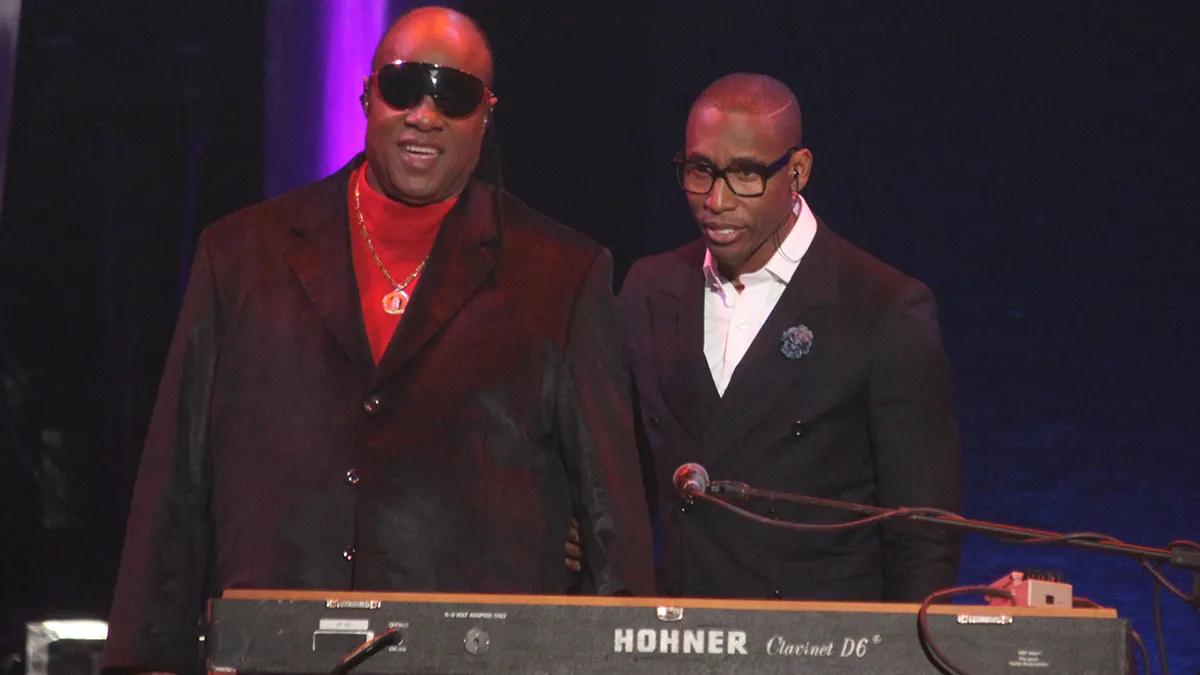
Martin Gore: I think there are various themes on the record. There are moments where it does go off into some spiritual realm. Two of the songs, I wrote back-toback: “Peace” followed by “Little Soul.” They were, for me, quite spiritual sounding. Although they sound nothing like it, it almost felt a little bit like something from [Stevie Wonder’s] Innervisions. There’s something spiritual in that sense to them.

It might seem really weird to be talking about Stevie Wonder. There’s nothing that we ever do that really sounds like somebody else directly. I think it’s in my warped head, there’s something Stevie Wonder-like about “Little Soul,” like there’s something Marvin Gaye-like about “In Chains.” It’s something in the passion you feel from them.

What was the process like as you came into the studio?

MG: The songs were already written and demoed before we got together in the studio. So, versions existed that showed the songs in a certain light. It was just a question of whether we wanted to continue down that path, and just make that version better, or take them off on tangents. We usually spend the first few weeks of an album deciding what we like about the demos and trying out different approaches.

Andrew Fletcher: The great thing is, we don’t waste time writing in the studio. The whole process in the studio is to get the best possible vibe and atmosphere for the song. We did four sessions, two in New York, two in Santa Barbara . . . we had about 22 songs when we went in the studio. We’d set up in the studio room, not the control room. We’d work on a song for two to three days, stop, move on to another song, then go back [to previous ones] three, four, maybe five times.

Martin, how did you assemble your demos?

MG:I think one of the reasons why I was so prolific writing for this record was that I was doing it all on a laptop. The only time I did anything external to the laptop was when I recorded a vocal or played guitar. That’s just so much quicker, to work that way. There’s no plugging anything in; it’s just all there in front of you. I found it quite inspiring, because I’d never worked that way before.

What software did you use for this?

MG: [Apple] Logic, because I find it very simple. Everybody else runs [Digidesign] Pro Tools and Ableton Live. I was really into all this virtual stuff. I literally used to go onto kvraudio.com daily — I think I’m a bit OCD — to see what new soft synth had been released that day, just to check it out. So that was for the recording of the demos. That compulsion moved to real instruments for the recording of the record.

How did you translate these demos to the final version?

Ben Hillier: I think Martin owns pretty much every soft synth in the world! The technique for each song would be first, to get Martin’s track — we’d usually end up with it in Ableton because it was much easier to change pitch and tempo. Then we could move it around until we got the key and the speed right for how we wanted to finish the song and how it would fit Dave’s vocal best. So we’d start with this finished song, pull it apart, change different parts, then build it back up again. We got to the point where we could do that very easily; it got very freeflowing. Quite often we’d end up with a lot of the lines Martin had programmed during his demos, but reworked on new synths or cut across several different synths.

I understand that Martin has developed something of an eBay habit.

MG: It’s funny because Moby is also on our record label, EMI. [Apparently] while I was going through a vintage drum machine fetish, so was Moby. So, I imagine these scenarios where Moby and I are sitting at our computers trying to outbid each other.

We used to laugh, saying, what has the universe got in store for us today? Often I would buy things on eBay, and you never know when they’re going to turn up. I was having them delivered to the studio, and these boxes would turn up randomly. We’d excitedly open them, and they’d usually find their way onto the track that we’re working on. [To learn what gear Martin brought to the sessions, scroll to the bottom of this page. - Ed.]

One of the rarer synths that I managed to acquire was a Steiner-Parker Synthacon, which made quite a few appearances on this album. It’s got some weird note-stealing thing, if you hit it right, you can play a threenote chord — it’ll actually play all three notes at once.

There’s a distinctive, coherent sound across all the albums’ musically diverse cuts — definitely a signature sound for the band. Can you talk about how your sound has changed over the years?

AF: It’s constantly evolving. It’s quite obvious if you hear our first album, Speak and Spell, that Martin’s writing was different. In the ’80s, we were purely an electronic band, although we were originally guitarists. For seven years, we never touched a guitar. Now, we’re using it more as a texture on this album.

Generally speaking, rather than retro, Universe is a more modern-sounding album. We’ve used a lot of vintage synthesizers that are much warmer, much grittier, but we’ve amalgamated them with modern, virtual instruments. When we made Speak and Spell, we only owned three synths. Just having all these instruments coming in was very inspiring.

MG: When you start analyzing all the tracks, they’re quite eclectic. There aren’t any two tracks that sound the same. They are very different, tempo-wise and feelwise. But somehow, the whole thing works. I like to think of it as some kind of ’60s space-age pop.

Speaking of space-age pop, I hear a little BBC Radiophonic Workshop influence in there — is [composer] Delia Derbyshire in the back of your head, as well?

MG: [Laughs.] Delia’s name came up a few times during the making of the record. In fact, Ben was telling us that, oddly enough, his mother gave him — out of the blue — a really early Delia Derbyshire record when he was a kid, and said, “You might like this.” So that was there.

There’s a rhythmic drive behind this album, too, yes?

MG: I find that this album for us is more uptempo than the last few, possibly because I’ve been listening to more uptempo music. It’s not that we’ve made an out-and-out dance album, but it’s definitely faster than Exciter, which was very ambient and atmospheric. On Universe, we spent a lot of time on the rhythm. Usually the basis of the song came from the drums and bass; that formed the main skeleton, and then the rest of it was icing on the cake. Maybe that’s why this one’s got a bit more of a drive.

An extraordinary number of bands have been influenced by your sound. What’s it like hearing their work?

MG:I never hear Depeche Mode in the bands that cite us as an influence. I think they’re more influenced by the instrumentation we’ve used over the years than by the actual sound. I don’t know . . . everyone from MGMT to the Killers, I don’t really hear Depeche Mode in there. It’s a great honor that those bands cite us, but I think it’s more the fact that they use keyboards or something.

I’m struck throughout the album that, while it does feel loud in the way the last record did, while there is a density to it, you get a sense of space. Can you talk about how you achieved that?

BH: I think on the last album, we tended to layer things a lot more, and to make it really dense-sounding. On this record, we didn’t want to do that. A lot of the things that Martin had been listening to were minimal techno — the sense of space in that sort of music was great.

MG: There’s a lot of things happening, but somehow there still seems to be an illusion of space. It’s nice, because the subtitle for this album is “songs in the key of space.”


0509 Ben Hiller DMGetting “Wrong” Right

Starting from demos by Gore and Gahan, the band took a “live in the studio” approach to sculpting final song versions, each member having one or more production stations consisting of a MacBook Pro and a slew of vintage synths. They typically worked in free-roll — just letting Live or Pro Tools run like a tape recorder — to get grooves without syncing away the character of parts they’d played live or generated from an analog sequencer or Akai MPC. Producer Ben Hillier (shown at left) describes the process for “Wrong,” the album’s first single:

“The arpeggio that runs throughout ‘Wrong’ was taken from Martin’s soft synth demo, then reprogrammed on my modular synth, using a sine wave from a Cynthia Zeroscillator,” says Ben. “We also ran a version using a vintage EMS VCS3 and Tension in Ableton Live — which we recorded through a vintage Gretsch guitar amp in the studio’s clanky basement! Different treatments of the sine wave used waveshapers in the modular, Max/MSP, vintage spring reverbs, and guitar pedals. The bass line was originally played live — me on keys, Martin working the filter — on a Roland SH-09. We then doubled it on an Elektron SidStation and Roland Jupiter-6. The drums were from an Akai MPC1000, played in free-run and treated through various bits of modular and EMS synths. We did just a few takes until the timing felt good with the backing track.”


0509 Depeche Mode Martin in Studio Martin Gore (left) plays an ARP 2600 synth as recording engineer Ferg Peterkin looks on - that round object on the ARP's keyboard is a Chimera BC16, a handmade patchable analog synth. In the background (left to right): EML Electrocomp 401 sequencer, Apple MacBook Pro, EMS VCS3 synth, Korg SQ-10 analog sequencer and MS-20 synth. At the far right is an Oberheim Matrix 12. That tiny keyboard at the foreground, slightly left of center, is a rare PAiA OZ - you can see the oval speaker cutout on top.


Online Exclusive: More Behind-the-Scenes Photos!

0509 Ferg in DM StudioEngineer Ferg Peterkin working with Mac Pro and Euphonix MC-Mix control surface. The ubiquitous EMS VCS3 is  behind him to the left, and the equally ubiquitous ARP 2600 is in that slanted rack in the top right corner of the picture.


0509 Depeche Mode drum machinesJust some of the vintage drum machines acquired as a result of Martin Gore's eBay obsession.


0509 Depeche Mode cases Lots of keyboards and drum machines in their cubbyholes in protective flight cases. We can ID the Prophet-600 and the Roland SH-09 to its immediate right. Atop the right case is what looks like a TR-808 drum machine.


0509 Depeche Mode Keys FloorThe photo from our name-that-gear contest, now with product names unobscured (Watch our "Latest News" section to learn about the winners, who've already been notified personally.) Left to right: Roland SH-09, Roland CR-78 Compu-Rhythm atop model 104 sequencer from Roland's modular System 100 series, Korg MS-20 synth and SQ-10 analog sequencer, Yamaha CS-30.


 Sounds of the Universe Complete Instrument List

Hardware Synths, Modern

Chimera Synthesis BC16
Dave Smith Instruments Prophet ’08
L.L. Electronics Rozzbox 2
Spectral Audio ProTone
Studio Electronics MIDIMoog and SE-1X
Vermona PerFourMer

Hardware Synths, Vintage

Akai AX-60
ARP 2600 (3), Axxe, and Odyssey
Casio CZ-101
Crumar Spirit
Elektron SidStation
EML Electrocomp 400/401
EMS VCS3, Synthi AKS, and Vocoder 3000
Korg MS-20, MS-10, Minikorg 700s, 900PS Preset Synthesiser, Poly-800, Kaosillator
Moog Minimoog
Octave-Plateau Voyetra 8
Oberheim Matrix 12, Matrix 6R, and Matrix 1000
Paia Oz
Roland SH-03, SH-09, SH-101, Juno 6, Alpha-Juno, System 100 modular, RS-09, JX-8P with PG-800 programmer, and Jupiter-6
Sequential Circuits Prophet-600, Pro-One and Multi-Trak
Steiner-Parker Synthacon
Suzuki Omnichord
Yamaha CS-5 and CS-30

Analog Modular Synths

Modules from Analogue Solutions, Analogue Systems, Blacet, Cwejman, Cyndustries, Doepfer, Harvestman, Livewire, Metasonix, STG Soundlabs, and VoxGlitch

Drum Machines, Modern

Akai MPC1000 with JJ-OS operating system
Elektron MachineDrum SPS-1UW
JoMox XBase 888 and MBase01
MFB-502

Drum Machines, Vintage

Ace Tone Rhythm Ace FR-3, FR-7M and CR-7030
Boss DR-55
Korg KR-55B and MiniPops
Hammond Auto-Vari 64
Seeburg Select-a-Rhythm
Sequential Circuits DrumTraks,
Roland CR78 CompuRhythm, TR-330, TR-505, TR-606, TR-66 Rhythm Arranger, TR-707, TR-727, and TR-808.
Univox JR-5
Yamaha MR-10


Hardware Sequencers

ARP 1621, Korg SQ10, Roland 100m, EML Electrocomp 400/401, Analogue Solutions Oberkorn, Electro-Harmonix Clockworks, Yamaha CR-30 (in-built 8-step sequencer), FutureRetro Revolution

Software Sequencers and Hosts

Pro Tools, Logic, Ableton Live, Numerology, Renoise, Reason, Max/MSP

Soft Synths

MDA DX10, FXpansion Orca, Emagic Choir, Arturia Minimoog V and CS-80 V, NI Reaktor
Ableton: Operator, Analog, Tension, Orchestral Collection, Sampler
Sonic Charge: mTonic, Synplant
Ohm force: Symptohm, Frohmage, Ohmicide, Ohmer Synthson
WayOutWare KikAxxe and TimewARP 2600
Metasynth
iZotope iDrum


Leave a Comment
Name:
Location:
Average Rating :
 

Chester Thompson B-3 Master Class

Ten Minute Technique - Warming Up Under the Gun

The Chord Doctor - Expand Your Chordal Command

Get Funky on the Rhodes

Synth Sense - Hot Synth Licks for Non-Synth Players


What's the best recipe for the image on the cover of Keyboard each month?
 
Subscribe Live Bookmarks Advertise Contact Us Privacy Policy Terms & Conditions


Keybord Magazine is a trademark of New Bay Media, LLC. All material published on www.keyboardmag.com is copyrighted @2009 by New Bay Media, LLC. All rights reserved