Declaration Of Independence

 
Jon Regen


Marco Benevento was on the verge of becoming one of the great straight-ahead jazz pianists of his generation — when something happened.

“I was working really hard,” the 30-year-old keyboardist tells me from his home in Brooklyn, New York. “I was studying with [renowned jazz pianist] Joanne Brackeen at the Berklee College of Music in Boston, practicing ten hours a day. I even won an award for ‘Most Outstanding Jazz Pianist.’ I was really trying to be that key that fits right into the lock — but it was a different key, and a different lock.”

Benevento initially thought he would follow in the footsteps of his elders, playing and recording jazz standards in a piano trio setting. But his eclectic musical tastes would lead him on a different path altogether. “I love Led Zeppelin and Pink Floyd, and all those weird, film score kind of sounds,” he continues. “I love rock, but I also love jazz. So now I see that where I ended up really makes a lot of sense, because I’m combining all those worlds of rock and jazz, improvisation and weird sounds.”

Where Benevento ended up, almost accidentally, is at the forefront of cutting-edge improvisational keyboard music. As half of the acclaimed Benevento/Russo Duo, he demonstrates both the intimacy and power that a keyboard and drum combo can impart. On albums like Best Reason To Buy The Sun and Play Pause Stop, Benevento combines organic organ and electric piano textures with mutating loops and effects. His always surprising keyboard work, set to Joe Russo’s dynamic drumming, has won him legions of fans, and keeps him on the road for some 280-plus live dates a year.

Now, with the release of Invisible Baby, Benevento builds on the sonic foundation he laid in the duo with Russo, and expands it even further, using a jazz trio’s sense of interplay to anchor his sonic explorations. Songs like “Bus Ride” and “Record Book” sound like modern rock radio hits, minus the vocals — like a meeting of Coldplay, Fiona Apple, and Tori Amos. Full of rhapsodic piano work and absorbing electronic soundscapes, it’s a compelling musical voyage.

FROM THE STATE THAT BROUGHT YOU BON JOVI

Benevento began his musical journey in suburban New Jersey, with a steady diet of piano lessons, family sing-alongs, and summer jazz camps. “I took piano lessons and learned how to read,” he recalls. “My parents had bought an upright piano for the house, and I played it even before I started taking lessons.

“My uncle played guitar,” he continues. “We’d get together and play Beatles tunes. And my Dad likes to sing. We have a really tight family. In fact, the Beneventos still get together every Sunday at 1:00 p.m. for pasta. Family has always been a big part of my musical life. So my cousins would come over to eat, my Dad would play Motown records, and we’d have sing-alongs. So there was always music in the house.”

During high school, Benevento started exploring a variety of musical genres, with a stint at the William Patterson University Summer Jazz Camp. “[Bassists] Rufus Reid and Todd Coolman were there,” Benevento continues. “As was [pianist] Jim McNeely. So that got me into improvisation, and I started checking out Oscar Peterson and Jimmy Smith. They were my introduction to jazz.”While many of his contemporaries would limit their jazz education to acoustic instruments, Benevento was immediately drawn to electronic textures beyond the piano. “I always liked the organ. I got into Jimmy Smith, which got me into Miles Davis and Bitches Brew. And then what really did it for me was Tony Williams. When I heard Emergency! I was like ‘Yes! There it is! It’s that grungy, organ sound.’ I thought, ‘How is he [organist Larry Young] doing that? And then I realized, ‘Okay, he’s playing his organ through a [Fender] Twin [Reverb amplifier].’ I wanted to get that sound. I had to get one of those!

“And I actually did get an organ,” Benevento continues. “A Hammond A-100 and a Leslie as a birthday present from my parents one year. They surprised me with it after I came home from music camp.”

IN THE LABORATORY

As his musical development progressed, Benevento began experimenting with different combinations of sounds — and the marriage of different musical genres. “I opened up the back of the organ and I started messing around with stuff,” he says. “I learned how to make a footswitch, and to get the sounds I was hearing in my head. That’s probably what led me to where I am now, playing shows live with distorted piano and delay. It all started back then.

“But even as I was learning about jazz,” Benevento continues, “I was still very much into rock. The Beatles, Led Zeppelin, Yes, and the Meters — I got way into their album Look-Ka Py Py. I just thought it was incredible. Their parts were so interlocking.”

Still in high school, Benevento began leading his own bands, playing bass and lead lines simultaneously on different keyboards. “I had a band called the Riddlers. We played sweet sixteens, and we played the Who’s ‘Baba O’Riley,’ and tunes by Phish and the Doors. I played bass lines on a Korg PolySix, and organ lines on a Kawai K1 and a Farfisa Compact Duo. ”

The improvisational experience he gained at that time made a deep impression on Benevento, one that remains to this day. “I got really into improvising back then,” he says. “I would record myself on the Kawai with a delay pedal — playing in E for 20 minutes into my four-track. Then my friends would come over, and we’d turn the lights off and just play in one key, listening to each other. I really feel like I learned a lot about music by doing that.”

BERKLEE & BRACKEEN

Benevento left New Jersey to study at Berklee, where he apprenticed with Joanne Brackeen. “Joanne actually came up to me after class one day,” he recalls, “and asked me ‘Do you practice?’ And it made me realize that even though I was playing all the time, and doing gigs, I wasn’t really practicing. She ended up inviting me to come and study with her, which floored me, because I looked up to her as a teacher, and as a musical spirit.

“She called me out on every weakness I had and made me get better every week. She pushed me and I kept on going back for more. It worked. If it wasn’t for her, I don’t know where I’d be now. She made me get serious.”

THE ACCIDENTAL DUO

Benevento moved to New York City soon after graduating from Berklee. He sat in at jam sessions and practiced piano around the clock, sometimes playing three gigs in a single day.
Initially, he had hopes of leading a standard jazz trio. “I wanted to be a jazzer,” he recalls. That was, until he ran into his junior high school friend, drummer Joe Russo, in 2001. “Joe and I hadn’t seen each other in years,” Benevento says. “We ran into each other in New York, and started playing gigs together around town. I had my Hammond A-100 chopped so I could move it around in my Subaru, but I still had the foot pedals connected so I could continue to play them.

“Joe got an offer for a weekly Thursday gig at the Knitting Factory in Manhattan,” he continues. “It only paid $100, so we decided to do it as a duo, so that way we could each keep $50. The club was empty at first, but slowly, people started coming out to hear us. There were articles being written about this ‘experimental downtown improvisational duo,’ and the word started to get out. Soon, the house was full every week. And it was crazy, because we only started playing duo to keep the money to ourselves!”

Within months, the Benevento/Russo Duo began touring to capacity crowds across the country. “I booked a three week tour for the duo, from New York to California and back,” he says. “We went in to a studio in Astoria, Queens and made a record on the cheap to tour behind. Then we got in my Subaru — me and my organ and Leslie, Joe and his drums — and we toured across the country. And the music started to catch on everywhere we played. It was a unique thing, just Hammond organ and drums, with an amazing musical connection between the two of us. Plus, I had the organ running through the Fender Twin, and through different effects and pedals, with loops on top. I was going for that same gritty Larry Young organ sound I heard on Emergency!. It surprised people.”

Word of mouth continued to spread, with the Benevento/Russo Duo playing to larger crowds and festivals across the United States. More albums followed, as did high profile tours with Mike Gordon and Trey Anastasio from Phish. “I always loved the way Phish improvised together,” comments Benevento. “They had an amazing interplay — very much in the style of jazz, but still very much their own thing.”

TRIO FOR THE NEW MILLENIUM

2007 saw the release of Benevento’s critically-acclaimed triple album, and his first as a leader, the aptly titled Live At Tonic. An eclectic mix of musical styles, sidemen, and repertoire, it also documents the keyboardist’s month-long residency at the fabled New York venue, which has since closed down.

Just seven months after the release of Live At Tonic, Benevento returns with Invisible Baby, a multi-dimensional studio recording that presents the visionary keyboardist at the top of his creative game. “This trio record is the result of everything I’ve done — going to school, moving to New York, then getting caught up in this amazing duo. It’s a combination of the jazz world and the electronic, rocking duo world.”

Benevento recorded Invisible Baby in two days on two different coasts while on tour supporting Live At Tonic. It was Chamberlain, whose music Benevento first heard while studying with pianist Brad Mehldau, who provided the impetus to record the trio in mid flight. “We had a day off in Seattle during a string of West Coast trio dates,” Benevento says. “Matt said ‘Let’s go into the studio and document the trio.’ So we went in and played my new tunes, and some of the ones that I had never recorded before. It’s like the accidental album — it basically recorded itself.”

On Invisible Baby, Benevento experiments with the collision of electronic effects and acoustic sonorities. He sends pianos through movie projector amps and distortion pedals, bathing them in sonic beds of vintage Mellotron tape loops, banjo lines, and, of course, his circuit-modified toys. On the song “Atari,” Benevento actually scrolls through the variety of available waveforms on the Korg MicroSynth while playing an arepeggiated riff. The effect is almost vocoder-like. “I’m turning the knob as I’m playing,” he comments. “And the waveforms change underneath.”

Invisible Baby is a modern instrumental rock record that flows like a live jazz album. It also manages to infuse a sense of tenderness and discovery that Benevento sees as an affirmation of love for his family and newly arrived daughter. “Having my own family made me realize what’s important. I’ve gotten the chance to build my nest at home, and it’s grounded me. It brought a whole new wave of inspiration. I was writing every day. ‘Are You The Favorite Person Of Anybody’ and ‘Ruby’ came out of that period, that new beginning.”

COURAGE

In early 2008, Benevento will mount a weekly Thursday night residency at New York’s Sullivan Hall. He’ll have his Baldwin grand piano moved to the venue for the run, along with his myriad effects and circuit-bent contraptions. Some of the recorded loops from Invisible Baby have been isolated in Pro Tools, and transferred to Benevento’s array of pedals, so that he can accurately reproduce the soundscape from the album. “I want my rig,” he says. “I want to have my piano, and my effects. I want the piano to feed back, just like it does on the record.”

In addition, Benevento will mount a tour to support Invisible Baby and start planning the next Benevento/Russo Duo CD, due out sometime in 2009. But regardless of the band or configuration, Benevento remains steadfast in his determination to carve out his own path through the musical landscape. “Back at Berklee, I was reading the liner notes to Stan Getz’s album The Dolphin. And in them, he talks about the main things that make a musician who he is. One of those things was courage. I wrote that down, and used to look at it while I listened to records. It made me realize what was important — doing something unique, and being courageous about it. That was a watershed moment for me.”

MARCO’S KEYBOARD CAVE

Marco Benevento’s vintage keyboard collection resides in what he calls his “keyboard cave,” a fully soundproofed music studio on the lower level of his Brooklyn, New York, apartment.

Centered around a Baldwin grand piano, (played through a Dean Markley acoustic guitar pickup and reel-to-reel tape tube amplifier), the studio also features scores of vintage Wurlitzer, Rhodes, ARP, and RMI electric pianos; a Farfisa Organ (“with the ‘slalom pedal,’” Benevento comments); and numerous effects pedals. Also on display is a vintage Rheem KeeBass keyboard, an antique pump organ, a marching band bass drum, and a psychedelic paint-adorned Korg PolySix.

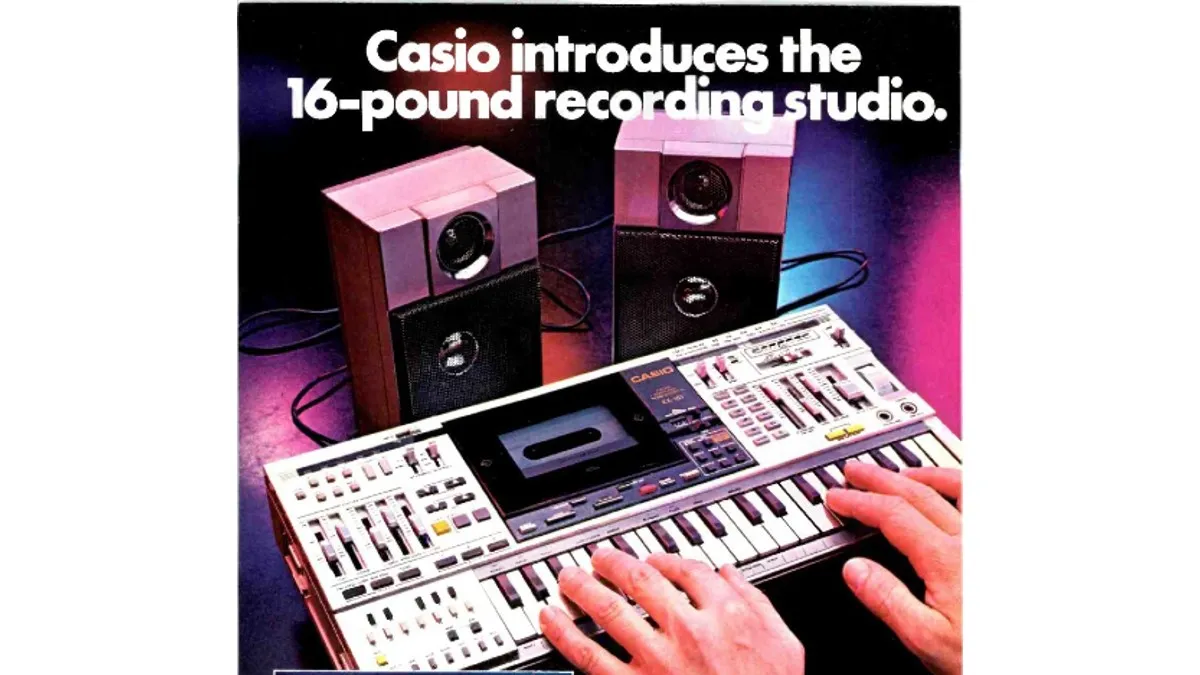
A portion of Benevento’s trademark sound comes from his collection of circuit-bent toys — from modified Casio keyboards to myriad electronic children’s games, Marco finds music in the most unlikely of places. “Circuit bending,” he says, “is when you take your old battery operated toy, and you take it apart. You intercept wires on the circuit board and insert toggle switches, or a light sensor, or pitch knobs.” He demonstrates with an electronic Chinese prayer box: First it “chants” normally, but then he turns the knob on its side, and the pitch drops until the sound is an unrecognizably mutated version of its former self.

“I like what these do,” Benevento says regarding his circuit-bent toys. “They create a layer of fills and weirdness.”

A Selected Marco Benevento Discography

As a leader
Live At Tonic (Ropeadope)
Invisible Baby (Hyena)

With The Benevento/Russo Duo:
Darts  (Benevento/Russo Duo)
Best Reason to Buy the Sun (Ropeadope)
Raw Horse (Pony Canyon)


Leave a Comment
Name:
Location:
Average Rating :
 

Finger Independence

Chester Thompson B-3 Master Class

Ten Minute Technique - Warming Up Under the Gun

The Chord Doctor - Expand Your Chordal Command

Get Funky on the Rhodes


What type of product has improved the LEAST over the past 10 to 15 years?
 
Subscribe Live Bookmarks Advertise Contact Us Privacy Policy Terms & Conditions


Keybord Magazine is a trademark of New Bay Media, LLC. All material published on www.keyboardmag.com is copyrighted @2009 by New Bay Media, LLC. All rights reserved