The Age Of The Killers

 
Tom Brislin


With their 2004 debut release Hot Fuss, the Killers emerged from Las Vegas and began defining the pop music landscape of this decade. Producing exuberant and glitzy hits like “Somebody Told Me” and “Mr. Brightside,” they helped catalyze a resurgence of ’80s synthesizer, vocal, and dance sensibilities, all infused in a modern setting of driving guitars and storytelling lyrics. With their follow-up release Sam’s Town in 2006, the band reached for edgier sounds and continued their streak of multiplatinum success.

Here, vocalist/keyboardist Brandon Flowers talks about iron-clad synths, golden lyrics, the “fan’s perspective,” and the Killers’ rousing new album, Day & Age.

Has your writing process been influenced by the lifestyle that you now have, with touring and widespread success?

Brandon Flowers: It’s hard for me to say. We’re always trying to write the best song, and you want it to be better than anything we’ve written before. When we first started writing, we wanted to be heard and it was the means to getting out of our jobs, and college, and the whole thing. It’s not a new idea. We got lucky, and now we’re spoiled. Songs come from a different place now. I guess you could say it’s to keep ourselves there, to maintain what we’ve attained.

But there’s a responsibility involved now, because of fans. I think about what music means to me, and what it meant to me when my favorite band had a new album coming out — they better deliver. You want it to affect you and change your life. There’s that kind of pressure now, to do something that’s meaningful. I think this album has moments that are meaningful, but we also let our hair down and it’s really fun.

Was this “fan’s perspective” in your head when you were writing the songs? Did you want to surprise people with a different sound, or did the songs just reveal themselves?

We talked a little bit about what it would mean if we wrote a pop album or a rock album, but you can’t make it happen. These songs just started showing themselves. They were more adventurous and more colorful, so we just went with the flow. You’ve got to do it for yourself first. The most important thing to me is that it moves me. I can’t think, “Are the fans going to like this, because it’s like ‘Mr. Brightside?’” I’ve got to be emotionally moved or I don’t want to sing it.

What comes first in the songwriting for you: the music or the lyrics?

It’s all about the chords and melody first. And then it’s like looking for the pot of gold, finding the lyrics. It’s a difficult task for me. I’ll usually sing the melody and something will show itself, like on a song like “Spaceman.” The chorus is just the first chorus that I sang, and it stayed there. I didn’t write it down. It was easy to build the song around that. It all made sense. So I’ll just take a line and find out how to make it come to life.

When you’re on the road, do you have much time to play and write on your own?

Some of these songs were written on the road. I’ll just usually have a cheap keyboard, like a $100 battery-operated job that I can bring with me on the bus or to hotel rooms.

How do you feel about the Killers as a live band in general?

We’re really becoming a great live band. With Sam’s Town, we had these big loud songs, and it was exciting every night. We aspire to be known for great live shows as well as good songs. It’s something that we’re working on.

What does it feel like to be a part of the Killers, now that you’ve achieved such great success?

It’s amazing. I still don’t quite have a grasp on how many people we’re able to bring together at once. It’s a celebration, and we’re there not to celebrate ourselves. Once it’s out there and people take it home, it’s not yours anymore. It’s ours. Doing shows, whether for 500 people or 40,000 people, it’s an amazing accomplishment, with what it does to the people and the room. It’s almost spiritual sometimes. You’re not thinking about anything else but that moment. That’s one way that bands can be positive. And that’s what it was like for me, going to see gigs.

Do you sense this feeling when you play around the world?

At the moment, there are two different sides of us: One side of the Atlantic, and the other side of the Atlantic. In Europe, they just take us in, accept us, and respect us. We’re still working on that over here. I think that will come with time.

Do you think the differences in acceptance between the United States and Europe is a cultural thing or an industry thing?

It’s been so bad in the record industry in America for so long, that it’s hard for people to believe that you can be real, and sell records, and be smart. It’s been a long time since the days when R.E.M. and U2 were still young, big, and ambitious. Even the Talking Heads — those were good times. It became a dirty thing in the ’90s. A shift started happening and [the popular music world] is so oversaturated now with junk. We’re not a part of any scene. Anybody who came up when we did four or five years ago is sort of fading away, and it’s a strange time for us.

Is there something you wish someone in your current position told you when you first started out?

People worry too much about their haircuts and their management, and they need to be worrying about their songs. That was the first thing I noticed that made us different from other bands. You really need to take a look at your songs. Are they really good enough?

We played a lot in Vegas. We weren’t very good, but our songs were good. There were labels that wanted to give us development- type deals. We almost did it, and I’m glad we didn’t. It came around; the more you play the better you’ll get.

It’s important to listen to people, too. You don’t have to listen to what everybody says, but if somebody tells you you’re singing out of key, tape your show. I struggled with that for a long time.

The other thing is: Don’t ever use a lawyer that the record label gives you, if you do get a deal in these dire times. It breaks my heart to hear that people fall for that one. It’s an evil business.

With Day & Age, was there something different from your last release, Sam’s Town that you wanted to go for?

I think we have an ability to write a certain type of song that maybe we neglected on Sam’s Town. A very modern song with these long, big choruses.

The album has a joyful sound to it.

Yes. There’s always been that element in our music. I think we’re optimistic, and we want to be a positive force. I keep saying that, but it’s going to come through our actions and our songs, hopefully. We’ve acquired some negative attention in the past, and I don’t like that. There’s enough negativity out there.

In the studio, are you still responsible for all the synth parts, or did your producer, Stuart Price, get involved?

Stuart got more involved in this one. I wasn’t reluctant at all about that, because I’ve never felt up to the task. Stuart is more of a connoisseur. It’s like how Depeche Mode had Alan Wilder; people like that who are truly tech savvy. Stuart has all kinds of great old analog gear.

What do you want your fans to take from Day & Age?

I want people to know that we’re not stuck, and that we’re really still searching. I feel like this album is the best thing we’ve ever done. I hope that our legacy is that we’re like navigators: a brave American band.

Recording the KILLERS

Was there anything about the production process for Day & Age that was a new way of working for the band?

Stuart Price: It was different than anything the band was used to. I was aware that they like to take their time to do things, and I spend a lot of time working in the studio. For me, I thought it would be really healthy to reverse that and actually do the complete opposite way: When we’re in the studio recording, let’s look at the clock on the wall and know that when that it hits midnight, we’re moving on to the next song. I think that injected a sort of urgency into the sessions, which is good because it makes the band perform spontaneously, but it also means you have to be really on top of your game with the recording and the engineer, and everyone has to be ready to go at any point. I think it puts a slight tension in the studio, which the band responded to really well.

Did the band record live at all, or do you prefer to lay down one track at a time?

It was a real mixture. There were some songs, like “Losing Touch,” that were cut 100 percent live and there were very few overdubs done. Then there were other songs, like “Let’s Save the World We Live In,” that was cut one track at a time. As a producer, you really have to listen to the song and see what the track leans towards or what it requires. The one common thread is that all the ideas came from one person’s gut reaction or just an instinct they had in that moment for that song. As long as it comes from someone’s heart, then that’s when the music you make has an “honesty” which is important for a band.

When I spoke to Brandon, he mentioned that you played a large role in terms of what types of synth sounds were going on. Do you have a go-to arsenal of sounds that you favor?

My main sounds come from my collection of analog synths. But it’s not just about the synths. I’m a big fan of analog sequencers as well, and not just using those to control keyboards, but to control live instruments. For example, you can run acoustic instruments through the circuitry of the analog synths and use a sequencer to control the dynamics. I like using effects and different ways of manipulating the sound. I tried this sort of thing in a rhythmic way with my effects more than anything because songs live and die by how strong the rhythm section is, so that’s a really important component.

When I’m traveling, it’s a different story because you can’t take an entire studio’s worth of equipment with you. Well, you can, but you’re worried that it’s never going to come back alive [laughs] and it gets expensive. So when I travel, I have these sample libraries I’ve built up, since I started using Akai samplers, that are probably an even blend of library sounds I bought and library sounds I made. I’ve always trolled through my record collection and sampled a kick here, a snare there, and a chord here. If I’m watching the TV or listening to the radio, or I’ve gone record shopping and bought something — if I just hear something good — I put it to one side and always have a pile of stuff to go through. I’ve built it up that way, and obviously when you’re traveling, that’s a lot easier to take that with you, especially when using the EXS24 inside Apple Logic, which was my main sequencer on the record. That’s probably where the majority of my tones come from.

Can you describe a specific example on the album where you ran instruments through analog synths and used sequencers to modify them?

There’s a track called “Space Man,” which has a lot of analog sequencers running. They were doing eighth-note patterns all the way through. I took Mark’s bass and that went through the filter of a Korg MS- 20, which had the sequencer, the SQ-10, synced up to the track. The bass was going through the filter and I set the sequencer so that each of the steps was controlling the lowpass filter on the MS-20. The effect of that was, rather than being obviously filtered with resonance boosted, to give the bass much more of a gated, pumping feel.

How would you define the Killers’ keyboard sounds on this album, and how would you advise readers to emulate that?

For keyboards, there were two things that we did. First, we used pads that would be as rich and full as possible. We would use sounds that were multi-layered — it was really over the top. But to contrast that, we tried to go thinner with monophonic synth sounds, and those we wouldn’t layer so much.

Good advice is always to set some limits and rules within the framework you’re working in. At the start of your project, set out with rules, like, “We’re only going to use this certain group of sounds.” If you do that, I think you’ll have a record at the end that sounds like it was made at a single point in time. I like early Cure records. One reason is they say that when they were recording them, they didn’t really have many options. They only had a monophonic keyboard, or they only had a certain amount of hours in the studio. I think that’s part of the reason why their records sound so distinct. Obviously today, the options are so wide open that most people have relatively easy access inside their computers to a huge bank of sounds and possibilities, and I’m not sure that’s such a good thing.

In the song “Human,” there’s one synth sound that comes in around the second verse or so. It’s sort of a single note line that repeats. What is that?

I believe it’s from a Polymoog. That sound actually came into the song very late. It was a very simple melody that was put in the right speaker. We duplicated and reversed it and put in the left speaker. That gave the sound a nice kind of revolving quality in terms of the stereo image, but it transformed it into a completely new melody.

Brandon Flowers Facts

Website: www.thekillersmusic.com
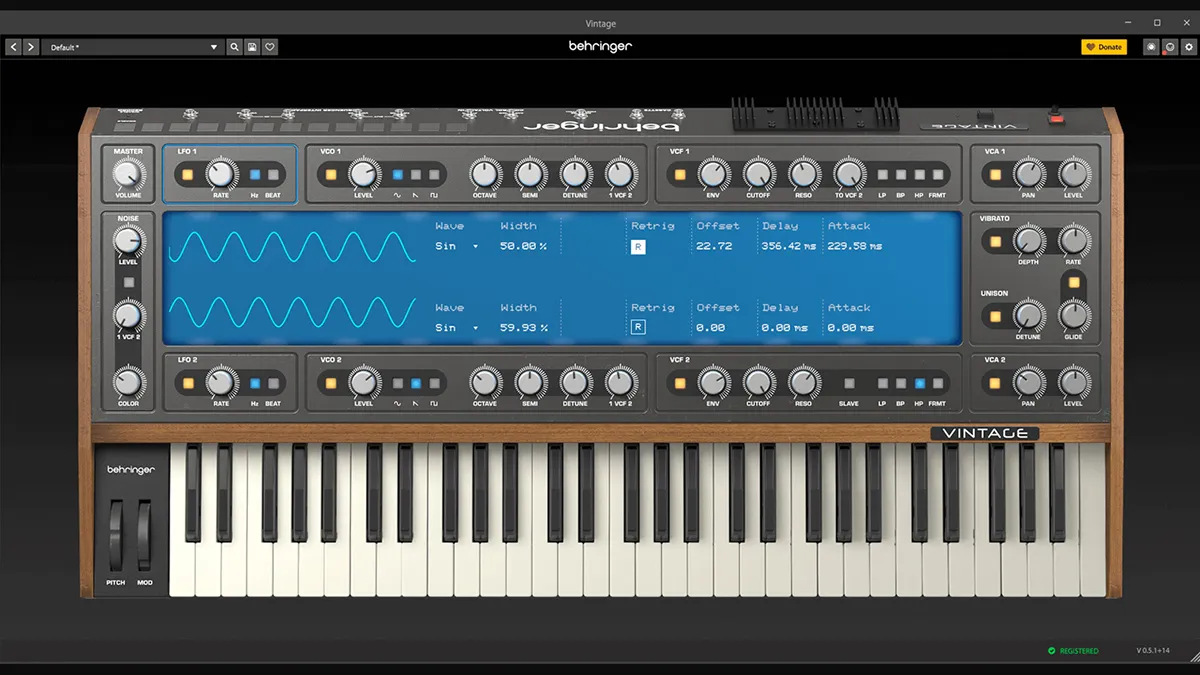
The keyboard rig: I don’t know if I could ever change it up. I may have used the MicroKorg before anybody else, and now you see every little band with one. Not to say that they’re copying me, but it’s just unbelievable. I’ve never had to change the one I use. It’s had beer poured on it and it’s fallen, but it’s never broken. I’ve gone through about four or five Nord Lead 2s, and the MicroKorg, this $350 little thing, it’s like steel. Now I just have that and the Nord Lead 2. For better piano and string patches, more realistic sounds, we have a couple of Yamaha Motifs played by our touring musician [Ray Suen], and another Nord.
Playing keys versus being the frontman in concert: I’ll always have things that I’m going to do, but the whole point is for me to be free [on stage]. There are some moments that I can’t imagine not being behind a keyboard.

Price Points

Selected production and songwriting credits: Seal, Madonna, New Order, P Diddy.
First Grammy: His 2004 remix of No Doubt’s “It’s My Life.”
Second Grammy: His 2006 remix of Coldplay’s “Talk.”
Alias used for above remixes: Thin White Duke.

A Selected Killers Discography

  image02          Day & Age (Island)    

  image03          Sam’s Town  (Island)  
                                                                       
image01               Hot Fuss (Island)


Leave a Comment
Name:
Location:
Average Rating :
 

Finger Independence

Chester Thompson B-3 Master Class

Ten Minute Technique - Warming Up Under the Gun

The Chord Doctor - Expand Your Chordal Command

Get Funky on the Rhodes


What type of product has improved the LEAST over the past 10 to 15 years?
 
Subscribe Live Bookmarks Advertise Contact Us Privacy Policy Terms & Conditions


Keybord Magazine is a trademark of New Bay Media, LLC. All material published on www.keyboardmag.com is copyrighted @2009 by New Bay Media, LLC. All rights reserved