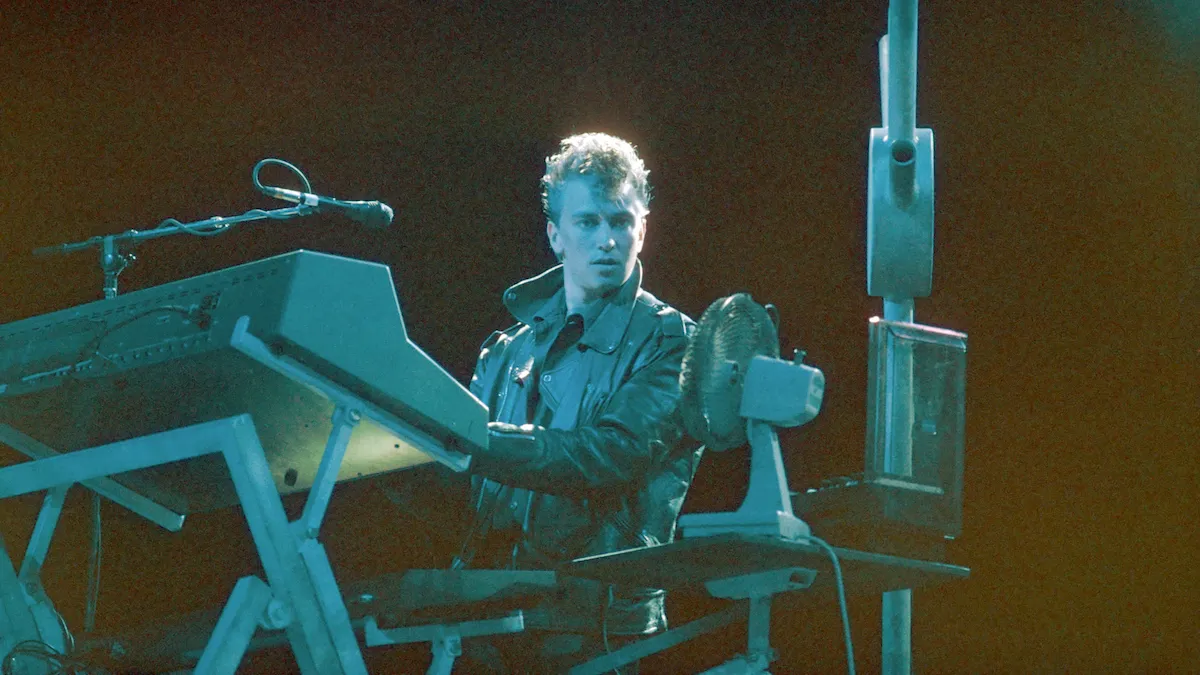
Update! We recently shot this onstage video of Matt Rollings in New York City, moments before he was to perform with Mark Knopfler. Matt shows us around his classy, piano and B-3-based keyboard rig. Can't see the video? CLICK HERE to open it in a new window.
Matt Rollings never planned on an A-list career in the Nashville music scene, but he was certainly ready when it came calling.
“I’m not from Nashville, but I spent 20 years there from’86 until 2006,” the now Los Angeles-based multi-instrumentalist, composer,
and producer says. In his quarter-century plus atop the pop and country music charts, Rollings has produced, toured, and recorded with
a veritable hall of fame of musical legends. Artists like Lyle Lovett, Johnny Cash, Kenny Rogers, Billy Joel, Trisha Yearwood, Bob Seger,
Randy Travis, Mark Knopfler, Neil Diamond, Tim McGraw, and countless others continue to call on him to inject his singularly sinewy keyboard
sound into their live and recorded work.
A CONNECTICUT YANKEE
Long known as a Nashville session ace,
Rollings actually hails from the East Coast.
His two-decade ride atop the very pinnacle
of country music would follow a circuitous
and sometimes accidental path.
“I’m from Connecticut and lived there as
a kid,” Rollings says. “We moved to
Chicago when I was nine, and my parents
found a piano teacher in Evanston, Illinois,
named Alan Swain, a well-known jazz
pianist with a teaching studio. I really
lucked out studying there, because his
teachers had a philosophy of turning young
people on to music. They taught the rudiments
— hand position, sight reading, and
technique — you had to learn how to play
the instrument. But as soon as you did,
they introduced you to an entire library of
popular music and blues songs.
It was a very jazz-geared philosophy,
and within my first year there, I was playing
these little blues tunes, and learning how to
play walking bass in my left hand. In hindsight,
their approach was brilliant — it did
indeed turn me on to music.”
Rollings would move with his family to
Phoenix, Arizona, in 1979, enrolling in a
musically-progressive private high school
with a top-tier jazz band.
“Up until that point, there’d been no
opportunity for me to participate in music in
school,” he recalls. “My past schools basically
had just concert and marching bands. But I
lucked out going to Phoenix Country Day
School, where a guy named Les Felton, Jr. ran
the music program. He had a little jazz band,
and I ended up bringing my Fender Rhodes
from home to play in it. Les was really into
teaching and promoting jazz to his students —
he took us to all the festivals, where we would
play across the country. I also went to a
summer camp called ISOMATA [Idyllwild
School of Music and the Arts] where I spent
two summers immersed in arranging and performing.
So by 16 or 17 years old, I knew this
was what I was gonna do.”
THE GIG THAT CHANGED
EVERYTHING
During the summer of his junior year in high
school, Rollings got a gig that set him on
his way.
“I had gotten a call from a bass player
for a gig in Phoenix,” he said. “It was five
nights a week with a house band in a local
club called Mr. Lucky’s. But what he neglected
to tell me was that the club was the
biggest honky-tonk in Phoenix, and the
band was a rocking, country band. It was a
massive complex with two huge rock and
country clubs in it. I had never played
country music in my life! I went down to the
audition looking like a preppy kid from private
school, wearing jeans and
Docksiders!” [Laughs.]
“The band was called J. David Sloan
and the Rogues, and they’d lost their piano
player,” Rollings continues. “I auditioned for
them and got the gig. That was the beginning
of this whole chapter for me. It was an
incredible band, where we’d learn two
songs a week of whatever was hot on the
country charts. How we’d learn these
songs was that we’d sit down and listen to
them, and write number charts.” Rollings is
referring to the vaunted Nashville numbering
system, where chords are called out by
their scale degree instead of their lettered
names — for example, if a song is in C and
the verse progression is C, Am, F, G, the
chart reads “1, 6-, 4, 5.” The same chart
can thus apply to any key, which is useful
when working with different singers. “That’s
how sessions are run in Nashville, and I
spent two years doing just that.”
LUXEMBOURG AND LOVETT
“In the middle of my run with the band, we
got called to do a whacky gig in the country
of Luxembourg for a summer music festival,”
Rollings says. “So we went there for
a month as one of three acts on the bill.
One of the other acts along with us was a
guy from Texas who was just playing solo.
It was Lyle Lovett. He was just out of journalism
school at Texas A&M, and was
over there playing solo between us and
another loud, electric band. So to compensate
for the sheer drop in decibel levels
when he went onstage, he
approached us about a week into the run
and asked if we’d accompany him on a
handful of his songs. We learned a bunch
of them — songs that eventually wound up
on his first album. When the gig ended,
Lyle actually came to Phoenix with us and
recorded 18 tracks with the band, paying
for the sessions out of his own pocket.”
“Later that year, I moved to Boston to
attend Berklee College of Music,”
Rollings continues. “I was convinced I
was going to be a jazzer. A year into my
studies there, I got a call from Lyle, telling
me that he got a publishing and record
deal, and that they were going to use
some of the original sessions we had
recorded for the album. Lyle wanted me
to play real piano on some of the tracks
I’d played Fender Rhodes on. So I went
to Nashville, and met Tony Brown, who
was co-producing the record along with
Billy Williams. Meeting Tony, who is
arguably the most successful producer in
country music for the last 20 years,
changed the whole game for me. He’s a
champion of musicians, and heard something
in my playing that he liked. He
started calling me to do development
demos for him. And that’s the point when
I realized that being a session player in
Nashville was something I needed to do.
So I moved there in ’86, and it’s been an
amazing ride ever since.”
THE BOOM YEARS
Rollings’ reign supreme as one of
Nashville’s most in-demand session players
began almost immediately after he
arrived in the storied city.
“It took about a year,” he recounts, “but I
showed up right at the beginning of the
boom years. The end of the ’80s and all
through the ’90s were the absolute gold
rush of Nashville session work. My timing
couldn’t have been better. I started working
for a guy named Jimmy Bowen, who at the
time was president of MCA Records. Jimmy
had at one time been in Los Angeles, and had produced Frank Sinatra and Dean Martin.
He was the first guy that said, ‘Matt, I’m
gonna start paying you double scale.’ So
from that point forward, I was not only working
constantly, but I had that kind of seal of
approval as someone paid above the normal
scale for the work they did. For that period of
time, I had more work than two of me could
do! Periodically I would go on tour with Lyle,
or Larry Carlton, or later [famed Dire Straits
guitarist] Mark Knopfler. But I made a conscious
decision to not just take any gig that
came my way. I can’t play the same thing
every night, or I’ll start turning into a typist.
So I chose my touring projects carefully. But
as far as records go, I think I’ve played on
600 of them — maybe even more.”
PROTÉGÉ AS PRODUCER
Rollings, now based in Los Angeles, is
busy as ever these days, playing, producing,
and composing for films. After
decades entrenched in the Nashville
scene, Rollings is making a name for himself
out West.
“One of the things I started doing in the
late ’90s was producing records,” he says.
“I had a bit of success, co-producing [with
Kenny Greenberg] Edwin McCain’s Misguided
Roses, with the hit “I’ll Be” on it. I
also produced Keith Urban’s first album as
well. But it was difficult to break out of my
role as a Nashville session player. At the
same time, I got the spark to compose for
films, so it was a natural progression to
move to Los Angeles, where all this work
is really done. I realized that the two things
that were keeping me in Nashville were
comfort and fear. And so within 48 hours
of thinking about the idea of moving, I had
made up my mind to do it.”
Rollings waxes practical when asked
for advice for the next generation of aspiring
musical greats:
“When I came up, the way that you
got into a career in music was that you
learned how to play music. A huge part
of my education was playing with people
who were older and better than me.
So any chance you can get to play
music where you’re terrified, and you’re
the worst guy in the room — take it! You
have to look for those situations.
Because nobody gets better sitting in
their room, recording themselves for
YouTube. You have to learn how to play
with other people.”
ROLLINGS’ RIGS
For his tours with Mark Knopfler, Matt Rollings uses a Yamaha acoustic grand piano and a Motif
ES8, along with a Hammond B-3 organ and a Baldoni Combo I Accordion. His Los Angeles, California,
recording studio is based around the following.
· Main controller: Yamaha Motif XS8.
· DAW 1: Apple Logic Pro 9 on eight-core Mac Pro.
· DAW 2: Digidesign Pro Tools 8 on quad-core Mac Pro.
· PC: GigaStudio 4 on two custom PCs.
· Soft synths: Spectrasonics Stylus RMX and Omnisphere,
Quantum Leap Stormdrum and Gypsy, NI Kontakt 4 and
Komplete 6, ProjectSAM TrueStrike and Symphobia, Synthogy
Ivory, Sonic Implants Orchestra, Vienna Symphonic Library,
Garritan Orchestra, Gforce MTron, Ilio Origins.
· Keyboards: Kawai RX7 grand piano, Hammond B-3, Fender
Rhodes Suitcase 73, Wurlitzer 200A, Minimoog, Roland Juno-60,
Sequential Circuits Prophet-T8, Harmonium, Farfisa Mini
Compact organ, Vox Continental organ, Hohner Melodica.
|