To the uninitiated, Phish is hard to explain. To their core fans — even harder. How do you describe Phish to someone who
has never heard the band or worse, has the wrong idea? Misconceptions usually boil down to some post-Grateful Dead narrative,
where a quirky cult jam band picks up where the Dead left off after Jerry died. This grossly misrepresents what Phish is all about.
True, like Deadheads, “Phish-heads” will follow the band anywhere, but as a musical entity, Phish is light years beyond what the
Dead ever aspired to.
Got a blank space
where my mind should
be.—“Stealing Time from the Faulty Plan”
To even attempt to categorize Phish, one
must look at the wide scope of their influences.
There’s a strong current of Americana,
with flavors of the Allman Brothers,
the Band, the Heartbreakers, and yes,
the Grateful Dead. But there’s also classic
rock, prog, jazz fusion, funk, blues,
R&B, soul, Latin, bluegrass, and country,
making Phish not just one of the greatest
American bands but possibly the Most
American Band. Add to all that reggae,
trance, and a healthy dose of the musical
universe Frank Zappa came from, and
you have an amalgam that draws from
more sources than any other band. But
to the members of Phish, it’s not about
labels and categories; it’s about communication
and listening.
“Certainly, Trey and Fish [guitarist Trey
Anastasio and drummer Jon Fishman] are
huge Zappa fans and some of the compositional
stuff we do hearkens to that,” says
keyboardist Page McConnell. “With some
of the jamming, we’ve often been compared
to the Grateful Dead or the Allman
Brothers — bands who like to stretch out.
We’ve tried not to be like any of them,
and shied away from sounding too much
like anybody. The jamming that we do and
the communication that happens when
we’re really improvising well together is
about the listening and the chemistry of
the four of our personalities. It’s not that
different to me when we’re having a conversation
than when we’re onstage playing;
it’s a very similar kind of energy and
free-form-ness.”
In an odd way, by sampling so many
genres of music, Phish has created their
own genre, labeled only by their name.
They can’t be pigeonholed as just a “jam
band;” if anything, they’re a progressive
rock band, yet not in the classic sense.
After experiencing 12 sets of mind-bending
music over the course of Halloween’s Festival
8 and their Miami New Year’s run, this
writer is less able to define Phish than ever.
That resistance to definition is one reason
why their fans love them beyond words and
why their “cult” status defies normal bandfan
relations.
Come hide in the herd
and float with the
flock. —“Ocelot”
The four members of Phish — Trey Anastasio
on guitar, Mike Gordon on bass, Jon
Fishman on drums, and Page McConnell
on keyboards — add unique ingredients to
the musical stew. Anastasio is the bandleader,
though all members can and do
sing and front songs in concert. Their connection
onstage borders on ESP, with a
Möbius-strip quality that weaves and bobs
amongst intricate melodies and time
changes. Though Gordon and Fishman
both do admirable jobs of holding down
the foundation of the music, it’s McConnell
who most often compliments Anastasio’s
melodic work. With a subconscious effortlessness,
McConnell’s keyboard comping
dances among the guitar lines, filling in
subtle spaces and adding to both the
rhythmic and melodic tension and release
of the music. The more you see and hear
Phish live, the more you realize the depth of
McConnell’s abilities. As a player, he runs
the gamut from Chuck Leavell-style piano
runs and funky Clavinet grooves to soaring
B-3 beds, tasty Rhodes comping, and
other-worldly synth explorations.
McConnell sits surrounded on three sides
by a fantastic rig (see “Page’s Phish Rig” on
page 25) which gets a full workout during
most shows. As a songwriter, McConnell has
a bit of a Steve Winwood vibe, which he displays
live with the band via his indelible solo
cut “Beauty of a Broken Heart.”
A love supreme, an
ancient art, a finely
tuned piano part. —“Beauty of a Broken Heart”
McConnell is Phish’s most versatile and
utilitarian member, adding textures and
sounds that can transform the band from
a good-time blues and boogie combo to a
trance-inducing psychedelic prog explosion,
often in the same song. From their
first studio album Junta right through to
their new release Joy, McConnell’s role
has developed in unexpected ways that
have fleshed out his own style as the
band collectively expanded their own
direction and definition. If there were an
evolution from Junta to Joy, it would be in
the tightening of the songs and the melodic
narratives that the instruments create
within. Where Junta had epic multi-part
adventures like “Fluffhead” and “The
Divided Sky,” Joy has more concisely written
pop/rock tunes like “Backwards
Down the Number Line,” the funky “Ocelot,”
and the haunting and uplifting title track.
Aside from the lengthy and ambitious
“Time Turns Elastic,” most songs are in
the three- to five-minute range and feature
some of Phish’s best hooks. Joy may
be one of the best records of 2009, but
in some ways, it’s miraculous that it ever
got made in the first place.
You decide what it
contains, how long it
goes but this remains. —“Backwards Down the Number Line”
The Phish of today is considered “Phish
3.0” by fans; Phish 2.0 came after a hiatus
in 2000 and this new chapter comes after
almost five years apart. Though they’re
touring again, the band’s primary goal was
to record an album. “Part of the reason we
got back together was the thought of doing
another record,” says McConnell. “We all
had material that we were excited about
sharing with the band.” They rehearsed for
over a month, leading up to their first
reunion shows in the spring of 2009 and
soon after, went into the studio with producer
Steve Lillywhite (U2, the Rolling
Stones) with whom they’d previously
worked over a decade prior on Billy
Breathes. “I enjoy working with Steve; we
have a great relationship,” says McConnell.
“Last time we were so much less experienced
in the studio at that point and we
were still sort of getting our feet wet, even
though we’d made a few records. We
started out the process in the studio without
Steve, in a barn in Woodstock. We did
a lot of experimental sort of things.” In the
studio, the band prefers to track live and
get that magic take. “When the four of us
track, generally we like to track with all four
of us playing at the same time and in the
same room if we can,” says McConnell. “As
much as possible, when we can use the
live tracks, we do. I overdub as little as possible.
On a song like ‘Joy,’ we ended up
overdubbing the whole piano track.”
Standing on the edge
of the cliff, I start to
slip, don’t mind if I
slide off. –“Sugar Shack”
To balance the succinct songwriting of
most of the record, Anastasio brought in a
13-minute epic called “Time Turns Elastic,”
which the band approached recording with
no prior rehearsal. “‘Time Turns Elastic’ was
a different animal altogether,” says
McConnell. “We had never heard that song
before, never tried to play it. Trey would say
‘Okay, I’m going to teach you the first 20
bars,’ and we sort of went piece by piece
and learned it. We’d play that chunk over
and over until we got a good take with all
four of us playing it right. Then we’d do the
next section, et cetera, and edit it all
together. With Steve Lillywhite’s help, we
were able to do it seamlessly. But all of the
piano on that song was from playing with
all those guys at the same time, even
though the song was chopped up and
spliced together.”
Of all the keyboards in his arsenal,
McConnell was often drawn to the piano.
“For the most part, I tracked piano on
everything except ‘Stealing Time,’”
McConnell says. “Piano is my go-to thing
and my primary instrument. I like to use all
of them, but if I can, I’ll play piano first. It’s
such a complete instrument with the
melody and the percussive quality and all
that.” When the band first started,
McConnell had a piano in the studio, but
live, he wound up using Mike Gordon’s
Fender Rhodes and Roland Juno-106.
Soon after, he got a Yamaha CP70 electric
grand, which he played right up until he
started touring with a grand piano.
Gonna dream, dream
of being free. —“Stealing Time From the Faulty Plan”
Live, the band is on fire, rejuvenated after
a long hiatus and enjoying the music
they’re playing. Their musical telepathy
produces moments of sheer brilliance,
though they give themselves room to
morph freely. “I don’t listen to a lot of our
concert tapes,” says McConnell. “But
sometimes I’ll hear a tape and I’ll be like
‘Man, it’s kind of meandering, it doesn’t
really feel like it has its footing’ and it’ll go
on sometimes ten or 15 minutes, and all
of a sudden it locks together and it’s like
‘Boy, if we hadn’t persevered, we never
would have found this cool thing.’ I think
that happens a lot, where it kind of goes
and goes, but hopefully we don’t meander
too much.” Though the recorded
songs give a foundation for those freeform
jams, McConnell isn’t tied to the
keyboard parts used on record. “I usually
start with something but try not to be
married to it,” he says. “When I’m playing
a song that has parts, usually I have
something that’s lined up for that. Very
little of it happens on the Rhodes or the
Yamaha [CS-60]; most of it tends to happen
on piano and organ, and some on the
Clavinet. When we’re jamming and it’s
going well, it seems like whatever it is
that I can reach for at the time is the right
thing to be reaching for.” One example he
gives is “Time Turns Elastic,” which they
now perform live. “I mix it up,” he says.
“Instead of starting on piano, I start on
Rhodes. I have a little bit of synthesizer in
there, too.” No matter how Phish performs
their tunes, the fans are always along for
the ride. “Our crowd is very encouraging,”
he says. “They really like us taking
chances and stretching out.” However, he
doesn’t pay much attention to fan or
press feedback. “I don’t read critiques
almost ever. I tend not to read anything
people say. If it’s praise, I don’t really
need that and if it’s negative, I definitely
don’t need that either [laughs].”
The song “Joy” sums up the mood of
the band these days, which is happiness.
There’s a feeling emanating from Phish 3.0,
a gratitude for the music and community
that they steward. Instead of the Dead, perhaps
they represent the grateful living, and
their fans overwhelmingly show it. At Festival
8, I asked a passing kid of maybe eight
years old how he’d describe the band, to
which he spouted, “Amazing, creative, and
rhythmic!” Leave it to a child to describe
the indescribable.
 PAGE’S PHISH RIGClick here for a video tour from Page himself!
On tour, McConnell plays a Yamaha C7 piano outfitted with hammers from a German
Steinway. A Helpinstill pickup run through an Avalon U5 direct box, plus an
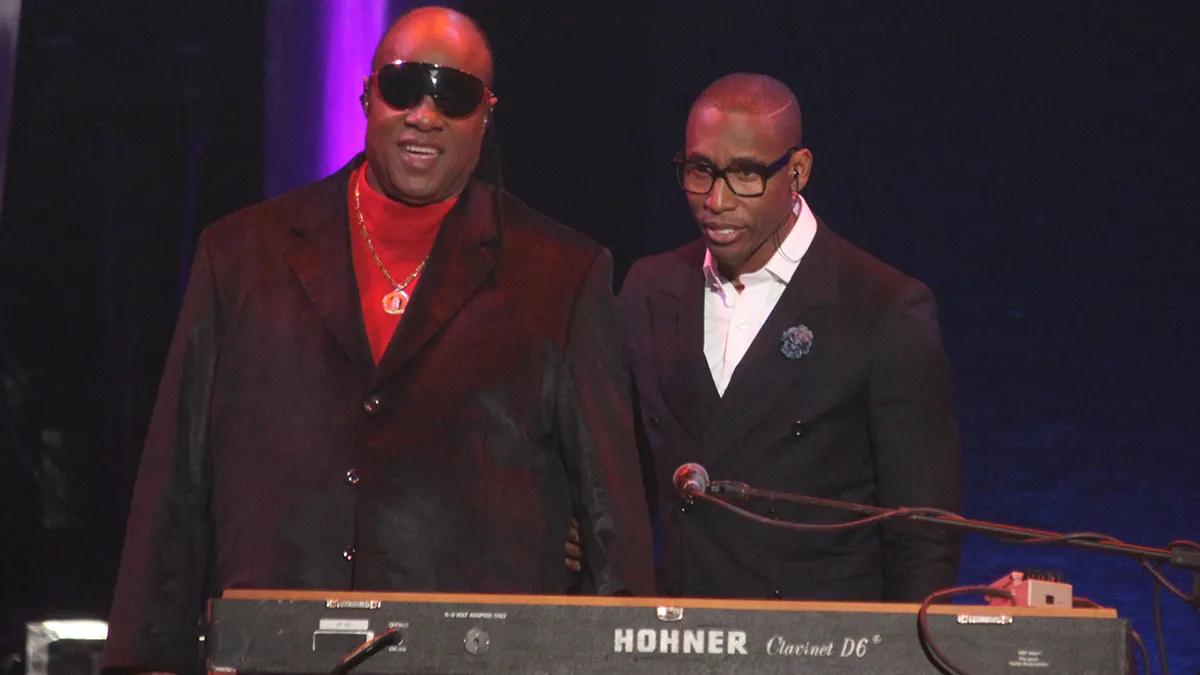
Earthworks Piano Mic system, feed the P.A. Then there’s the Hammond B-3, Hohner
Clavinet, Rhodes, Moog Little Phatty, and Yamaha CS-60. “Since I did my solo
record, I’ve been out with the Little Phatty and I really like it,” says McConnell. “Before
the Phatty, I used a Moog Source. I’ve had a few different keyboards occupy that particular
spot.” His Clavinet got quite a workout at Festival 8 on songs like “Down With
Disease” and “Ghost.” “People like the Clav,” he says. “It’s funky and it makes them
dance.” The CS-60’s flavor comes in handy for certain moods. “I use it more for the
spacious stuff and the ambient or spacey sounds. Pads and textures — I really like the
texture of Yamaha’s analog synths. I’ll start with one of the presets, like the flute or
brass sound, and mess with it.” However many vintage keyboards he owns,
McConnell keeps his live rig tight: “I try not to have more than six keyboards with me.”
|